Diving for a Greater Purpose at Georgia Aquarium
There is a moment in every dive — after the gear is checked, the team gives the final OK, and your body slips below the surface — that everything else fades.
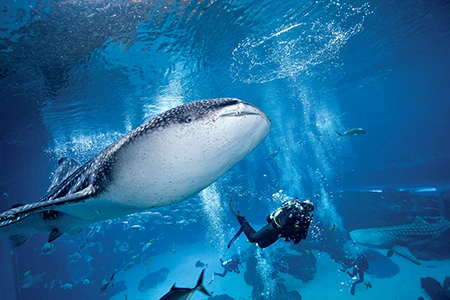
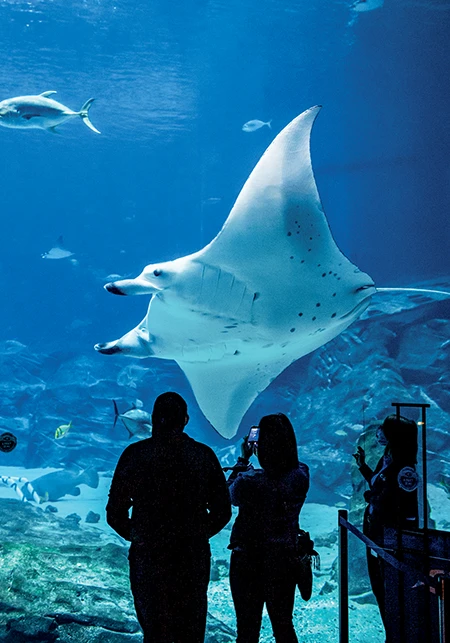
At Georgia Aquarium, however, that moment does not begin with a boat ride or a giant-stride entry. It starts inside a building in downtown Atlanta, surrounded by concrete, visitors, and towering exhibits. It begins with the low hum of life-support pumps, the smell of freshly brewed coffee, and cheery volunteers. It begins with a deep breath just before descending into a world where whale sharks glide past you, manta rays turn midwater loops, and the mission is far greater than yourself.
Welcome to aquarium diving, where the water and purpose are clear, and the stakes are higher than many people realize.
A World Behind the Acrylic
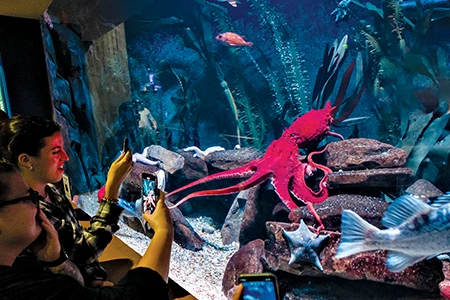
To the public, Georgia Aquarium is a place of wonder, as it is for the many staff and volunteers who help make it run. It is a place to come face-to-face with ocean giants, to watch children press their hands against the acrylic in awe, and to learn about ecosystems most people will never visit in person.
Behind the scenes, however, lies a complex, coordinated operation, and the dive operations team gets to support this mission every day as one of the largest aquarium dive programs in the world.
Every dive here supports something vital. We are not just maintaining habitats or feeding animals. We actively contribute to their care, conservation, and the larger mission of inspiring ocean stewardship in the millions of guests who pass through our doors each year.
It is technical, physical, emotional, and anything but ordinary.
The Path to the Platform
People often ask what it takes to become a diver for Georgia Aquarium. The truth is that a logbook is not enough.
Whether applying as a staff or volunteer diver, the process is intentionally extensive. Staff members must go through the hiring process, so specialties in their areas of expertise are essential. Each volunteer must already be certified to dive, serve as a volunteer for at least 50 hours, attend a diver information session, apply to the program, and have availability that meets the schedule.
A panel of current staff and volunteer divers interviews applicants and selects finalists, who are then invited to start the general onboarding procedures, which each diver must take and pass to join the team. The requirements include a dive physical with a dive medicine physician, our swim and dive evaluation, and a full round of safety and rescue training. At Georgia Aquarium, we require DAN’s Diving First Aid for Professional Divers course, a program I value immensely as a dive safety officer (DSO). It lays the foundation for how we operate as a high-performing team in a high-stakes environment.
The next step is diver orientation, which includes classroom instruction and an in-water evaluation. The course covers everything from Occupational Safety and Health Administration (OSHA) standards and dive operations protocols to emergency procedures and animal interaction guidelines. Only after successful completion are divers cleared to enter our habitats.
And even then, the learning never stops.
Many of our habitats are best navigated with surface-supplied diving rather than traditional scuba. Our divers train with full-face masks, hardwired communications, and air umbilicals to provide extended bottom time and constant surface support. This training is critical as most of our habitats are too small for scuba diving.
Most divers in our program are cross-trained in multiple systems, and everyone is expected to maintain readiness for their safety and that of their teammates and the animals we serve.
Safety Is a Culture, Not a Checklist
Meeting the OSHA 29 CFR Part 1910 Subpart T regulations for commercial diving operations is just the beginning. As DSOs, we must also uphold standards set by the Association of Zoos and Aquariums (AZA), the American Academy of Underwater Sciences (AAUS), and the World Recreational Scuba Training Council (WRSTC). Those agencies provide the dive regulations.
The aquarium must also comply with regulations set by the U.S. Department of Agriculture (USDA), the Marine Mammal Protection Act, the Georgia Department of Natural Resources, and many others to ensure we provide the best care possible for our animals.
Safety drills are embedded into our culture. Every month we run scenario-based training sessions across dive teams. These include sea urchin envenomations, equipment failures, and full diver-down responses.
I draw on my background as a paramedic to design scenarios that challenge the team’s communication, decision-making, and situational awareness under pressure. I also strive to create a positive environment that allows our team to learn and get better.
The goal is not to induce fear but to build muscle memory and kinesthetic awareness. We want every diver to feel confident in their responses long before they ever need them.
We have also integrated human factors and nontechnical skills into our curriculum. Psychological safety, assertive communication, and team situational awareness are just as important to us as buoyancy and air management.
These skills do not stay in the aquarium, however. Divers who learn them here carry them into open water, and that ripple effect is one of the most rewarding parts of the job.
No Such Thing as a Typical Day
There is no standard day in aquarium diving. One morning might start in the dive office, coordinating training schedules for our nearly 300 divers or reviewing compliance documentation. Another might have us in the water performing a complex dive in our coldwater gallery or observing a new diver navigate a coral reef habitat for the first time.
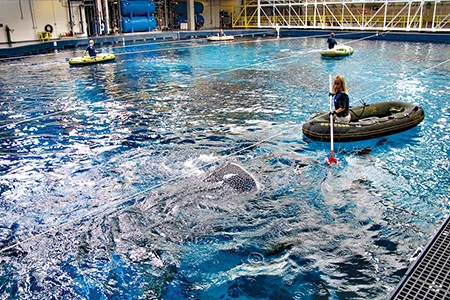
Our habitats are as diverse as the species we care for. They range from our multimillion-gallon habitat, Ocean Voyager, where our whale sharks and manta rays live, to smaller, intimate environments such as River Scout, where you will see our piranhas, tigerfish, and Asian small-clawed otters. Each habitat has its own dive protocols, animal behaviors, and daily maintenance requirements that we must adapt to for our dive plan.
We may not be battling current or surge, but aquarium diving demands precision, consistency, and an ability to work seamlessly with life-support teams, veterinarians, aquarists, and fellow divers. It is a dynamic workplace where every dive supports something living, breathing, and vulnerable.
It is also a place where mentorship thrives. New divers are welcomed into a team that values knowledge-sharing, mutual accountability, and shared responsibility. I take immense pride in watching divers grow in skill, confidence, and purpose.
Diving With a Bigger Mission
You will not find tidal charts or deep dives here, but you will find a chance to make a tangible impact. Every dive is more than a task. It is a message. It shows guests what is at stake in our oceans and why it is worth protecting.
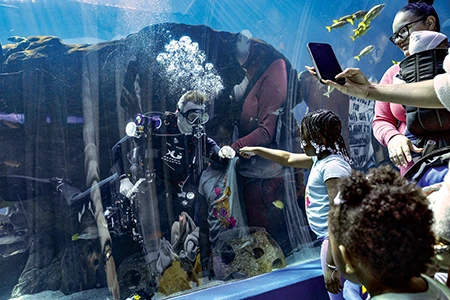
This responsibility is what makes aquarium diving different. Our job is not just to dive; it is to inspire. It is to help people fall in love with the ocean, even if they have never seen it in person. When guests see a diver caring for an animal or cleaning a coral wall with surgical precision, they witness more than maintenance. They are seeing a relationship built on respect and care.
That moment of connection, when a child locks eyes with a diver or an adult asks how they can help, is where change begins. Sometimes it is choosing sustainable seafood or becoming a diver themselves. And sometimes it is starting to care about the ocean in a new way.
And that spark is the real reason we dive.
Diving as a Calling
To many on our team, this is not just a job. It is a calling. We are professional divers, but we are also educators, conservationists, and caretakers. We have chosen a path that blends technical skills with emotional investment, and we show up every day because we believe the ocean is worth it.
The commitment is real. The early mornings, the high standards, and the weight of responsibility all come with the territory. But so do the joy, the awe, and the sense of being part of something much larger than us.
When you dive at Georgia Aquarium, you are part of a mission — one that reaches far beyond our walls and into the broader world of ocean advocacy.
Why It Matters to All Divers
As Alert Diver readers, you already understand the transformative power of diving. You have felt the silence of descent, the thrill of exploration, and the calm that only underwater time can bring.
I hope this glimpse into aquarium diving offers a reminder that no matter where we dive — the ocean, lake, spring, or aquarium — we carry the potential to make a difference. We influence others through our actions, training, and passion. When we uphold the highest standards, we help protect the environments
we love.
Diving here may happen behind acrylic, but its impact stretches far beyond our walls. We dive to care for the animals, build community, ignite curiosity, and help create a future where the ocean still thrives. And if we have done our job right, maybe someone who watched from the other side of the acrylic will one day dive in to make a difference too.
Jonathan Langham is the senior manager of dive operations and DSO for Georgia Aquarium.
Explore More
Find more about the Georgia Aquarium in these bonus videos.
© Alert Diver – Q3 2025