The Marovo Lagoon in the Western Solomon Islands is the kind of place divers dream about. The water is a beautiful turquoise, and the reefs are teeming with life.
In June 2025 my partner, Marco, and I traveled to the tiny island of Uepi for the dive holiday of a lifetime. I was a relatively new diver, and this trip would begin with my 17th dive. Marco, who is diligent and safety-conscious, had more than 800 logged dives. I never imagined that a textbook dive in perfect conditions would end with a medevac helicopter and a life-changing diagnosis.
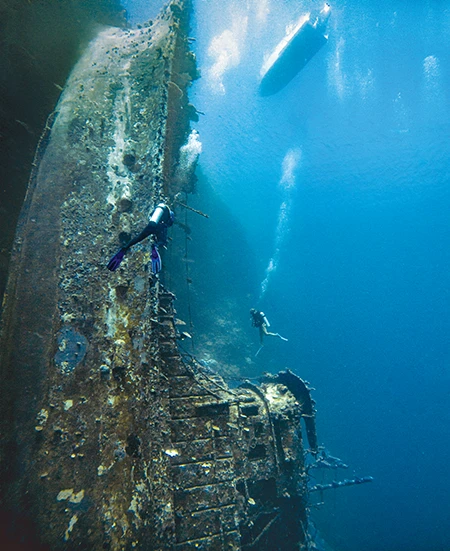
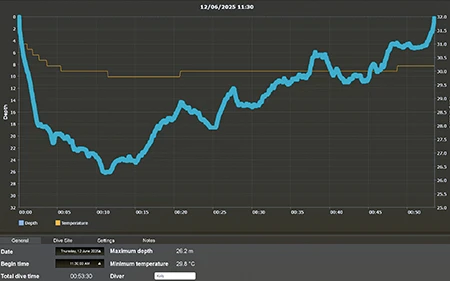
The conditions were flawless on the morning of my sixth dive of the trip. There was zero current, and the water was a warm 84°F (29°C). I had finished my previous dive 39 hours earlier. We took a small boat about an hour from the resort to one of the most unique sites in the region: the Taiyo shipwreck. The dive plan was conservative and relaxed.
We descended along the deck and reached the bridge at 85 feet (26 meters). After exploring with the flashlight and taking some photos, we slowly worked our way up, finishing with a five-minute safety stop at 16 feet (5 m). My dive computer showed a total dive time of 53 minutes, and we had no rapid ascents or struggles.
I handed up my weights, climbed the ladder into the small boat, and immediately felt a twinge of pain along the right side of my spine from my hip to my shoulder. I brushed it off, assuming I had simply twisted awkwardly while hauling my gear up the ladder.
The boat crew pulled the boat into the shallows and lowered the ramp onto a sandbar, where we planned to stop for lunch and a surface interval. When I stood up, the pain in my back spiked to an excruciating level.
After walking a few steps, I had to crouch to relieve the pain.
The right side of my abdomen contracted painfully, and it was difficult to breathe. My right leg was a deadweight. Within five minutes of the dive ending, I was lying on the sandbar in severe pain. We were an hour from the resort by boat, and the closest major hospital was nearly 200 miles (300 kilometers) away.
The boat crew didn’t hesitate. They suspected a dive injury and rushed for the onboard oxygen. Two people carried me back onto the boat, where the crew put me on 100% oxygen at maximum flow. I felt the sensation return to my leg after 30 or 40 minutes. The paralysis was mostly gone when we reached the resort, but I was still frail and shaky. The resort manager had more oxygen ready and had already alerted DAN.
The fear can be crushing when you are injured in a remote location. The moment I spoke with Dr. James Chimiak, DAN’s chief medical officer, was the turning point. He was calm and precise. After hearing the sequence of events, he suspected spinal embolism. A nitrogen bubble had likely entered my arterial system and lodged in my spine.
Despite my symptoms improving on oxygen, the situation was precarious. Chimiak insisted on an evacuation to the nearest hospital with a hyperbaric chamber in Honiara, the Solomon Islands’ capital.
A medical evacuation in the Solomon Islands involves complex logistics and massive costs. That was when my DAN insurance became invaluable. DAN immediately authorized and paid for everything and coordinated a low-altitude helicopter evacuation for the soonest possible time the next morning.
I spent the night on oxygen, anxious but grateful, knowing help was coming. The resort manager checked on me and changed my oxygen tanks every two hours throughout the night. A boat took us to Seghe airport at dawn, and then we flew low over the ocean and around the hills to avoid altitude changes that could expand any remaining bubbles in my system.
The head of the hospital’s emergency department, Dr. Trina Sale, met me when I arrived and had been coordinating directly with Chimiak. My symptoms had resolved significantly due to the immediate and prolonged oxygen and hydration, so the doctors determined that hyperbaric treatment was no longer necessary. After two days of observation, the doctors cleared me to fly home.
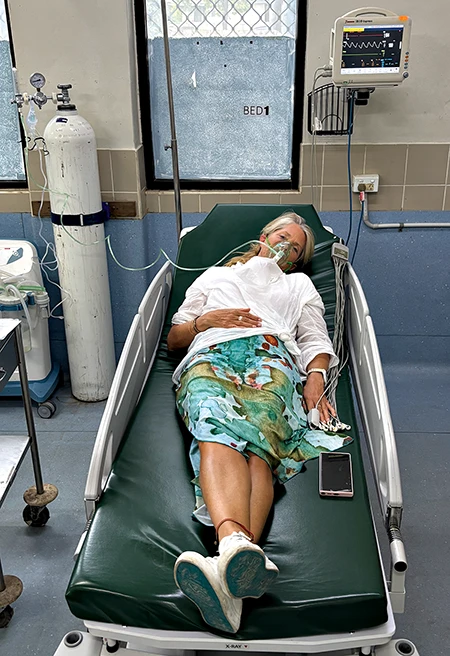
The real investigation began: How did a safe, conservative dive result in spinal embolism? I underwent a battery of tests: thoracic and lumbar MRIs, brain scans, an agitated saline contrast study, and a transesophageal echocardiogram bubble study. The doctors were looking for a patent foramen ovale, but all the tests came back negative.
The final diagnosis was a suspected pulmonary shunt — an abnormal connection between the arteries and veins inside my lungs. Instead of getting filtered out, a nitrogen bubble likely crossed into an artery and travelled straight to my spine.
The verdict is difficult to accept: I can never safely scuba dive again. The risk of another bubble crossing over is too high, and if it happens again the paralysis could be permanent. But I feel nothing but gratitude.
Spinal decompression sickness is notoriously resistant to treatment. The specialist who reviewed my case noted that without quick administration of high-flow oxygen, I would likely have had permanent paralysis.
My advice is to never dive without DAN. When I was lying helpless on a remote island, DAN didn’t just pay the bills. They provided world-class medical advice and logistics that a regular travel insurer simply cannot match.
I may have to hang up my fins, but thanks to DAN and a quick-thinking crew, I can walk away from the ocean on my own two feet.
© Alert Diver – Q1 2026