In search of beavers, my colleagues and I followed the Cap-Chat River on Quebec’s Gaspé Peninsula to a village of immaculate, steep-roofed houses that shares the river’s name. Near the village a red- and white-striped gate blocked the road, and a forbidding sign read, “Zone d’Exploitation Contrôlée.”
This ZEC was a controlled river fishing and recreation zone, managed by a nongovernmental organization. Quebec has 23 ZEC-managed rivers, many with thriving Atlantic salmon populations. We paid the access fee, and the rangers showed us a riverbend that often had beavers. I had waited years for the right conditions to film these intelligent aquatic rodents.
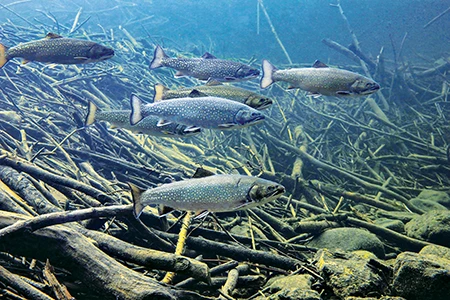
We dived into schools of big Atlantic salmon in the clear, spring-fed, limestone-filtered river. After exploring several pools we found a gazebo overlooking an oxbow curve. We saw signs of beaver activity: pointed tree stumps chopped off with precision, paw prints at the river’s edge, and big sawdust balls.
We also noticed the sweet, musky smell of castoreum, which beavers expel from their anal glands to mark their territory and warn away strangers. With strong family bonds and a high degree of territoriality, beavers will attack and kill beaver invaders.
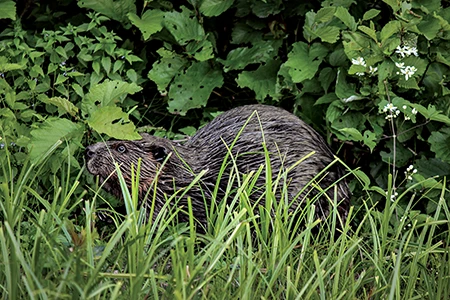
I noticed movement in the low bushes, and a big beaver appeared, dragging a sapling to the water. It was hard to believe this diminutive animal could pull something so large, but the beaver was adroit, using its strength and the slope to achieve the seemingly impossible.
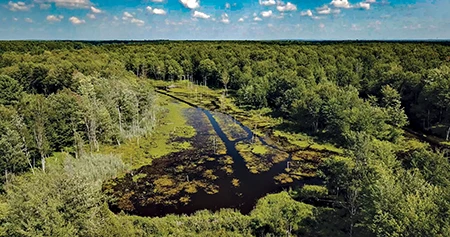
Three adult beavers were logging nearby and ignored our presence. We noticed extensive beaver constructions upstream and downstream: well-ordered piles of sticks with larger branches on each bank. The river was too swift and deep to be dammed, so the beavers had built parallel dams that fortified each side of the river.
Photographing beavers underwater is usually difficult because the bottom mud they pack into branches woven along the side of the dam reduces the current and creates a permanent mud hole. The parallel dams on this river, however, allowed for clear water flow, which meant good visibility. I donned gear and slipped into the water with some trepidation — I knew they could be formidable with their smashing tails and giant chomping incisors.
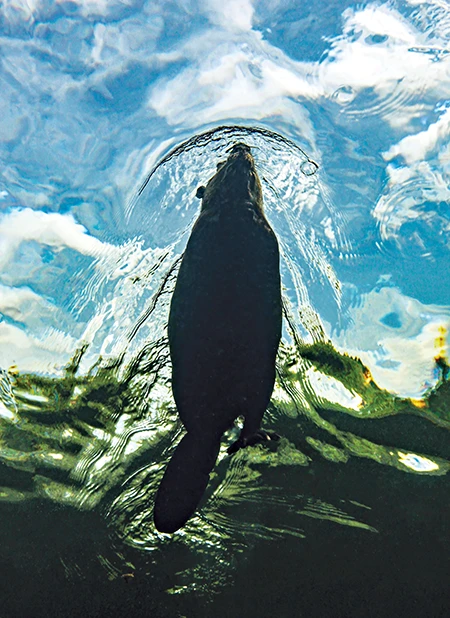
As I drifted near the main beaver lodge while trying to look nonthreatening, I could see ranks of carefully cut-off branches stuck into the river bottom and tiny fish swarming everywhere. A terrier-sized beaver appeared to my right, just off a mound of the lodge, and quietly swam a wide circle around me. I heard a moderate thwack as another beaver struck the water with its tail, exchanging messages about my alien presence.
Beavers have a muscular tail with a fibrous center. Like porcupines and dolphins, they have a chain of chevron bones running into the tail below the tail vertebrae. These bones provide extra real estate for anchoring powerful back muscles, making their tail an effective underwater propeller, sound-making device, and weapon.
Beavers have litters of three to six kits every year in late winter or early spring. The kits spend their first month in the den, nursing on fat-rich milk. They can form multigenerational families, but some young beavers leave their family unit after two years to make their own homes. The clan we visited contained 13 animals across four generations, indicating an environment rich in food and resources.
As we snorkeled, my colleague Jeffrey Gallant found the underwater den entrance and saw an angry beaver diving straight at him with its teeth bared. He fended off the animal, but not before it rammed his camera and flooded his mask. Both beaver and human rapidly retreated, but Gallant got a unique image of the beaver’s security duty.
A juvenile appeared and swam in a wide circle, fixing her brown eye on me before she went out of view. A second beaver emerged from the haze, making its way past me at a safe distance, and then also disappeared. Another followed it, and then another after that one. This beaver security detail kept me under continuous surveillance.
The beavers’ coats shimmered with tiny air bubbles that help retain warmth. The animals constantly groom themselves to maintain their natural drysuits. One of the patrollers nearby became alarmed and porpoised away, the water pressure forcing a raft of air bubbles from its coat, leaving behind a gently rising contrail.
Our group and the beavers became more at peace with each other during this long afternoon. We had the idyllic feeling of wild animals accepting our presence, not tamely, but without excessive fear.
The big adults with giant incisors were the serious loggers; their energy and persistence were amazing. Beavers do tremendous environmental good as they build their homes, which is especially relevant as the planet heats up and dries out. Dams and water diversion stop water from running off the land and into the ocean at every level up to the subalpine, which supports more plant life.
The increased flora drives biodiversity from amphibians to birds, and it helps slow water flow and increase nutrient retention and sediment deposits, which help stop erosion. The dams and sunken tree branches create fish habitats and spawning beds that benefit juvenile fish. Our visit let us see not just the beavers but also the good they were doing for biodiversity.
After I exited the river near evening, I had one of the most riveting and moving experiences in a lifetime of filming animals. I set up a long-lens camera in the bushes beside a shallow muddy bay pockmarked with beaver tracks, and I was unsure what would happen next.
The first beaver to arrive right in front of me was a big adult female who hauled out in the shallows only about 20 feet (6 meters) away. She began grooming herself, sitting in a Buddha-like posture, with her short forelimbs dreamily massaging her belly. Then a 1-foot (0.3 m) baby beaver appeared with a whining cry and began to nose around the mother’s side, continuously squawking. Mom rolled to one side and presented a mammary gland, and the baby burrowed in and latched on. Another baby joined her sibling a minute later.
The light turned golden while I watched this magic unfold in my viewfinder, leading to the next phase of this beaver social soirée. From the opposite side of the river, an adult beaver appeared with a massive aspen branch in tow. He pulled up into the shallows adjacent to the female and delivered the groceries.
Another adult appeared, and three smaller yearlings promptly followed, all converging on the mound of greenery. The babies left their mom and swam around, chomping on fresh aspen leaves, which their older siblings frequently stole directly from their mouths. The babies did some minor grousing, but all the other beavers showed amazing tolerance. This family collaborated, shared, and deferred to the young.
The whole clan took time for rest and relaxation after a hard day’s work, spending a quiet family half hour in the shallows. The older adults lolled like lords of the river, and five other beavers of different ages and sizes formed a circle, grooming each other’s backs. By the time the golden light faded, eight beavers were relaxing together in the shallows.
The next year my wife and I returned to the river to see how the beavers were doing, but the dams were gone and the riverbanks were bare. The gazebo was still there, so I walked down to the riverbank and found a single weathered beaver stick. The river felt deserted. What had happened to the beaver community? I did not see a single trout or juvenile salmon as I snorkeled.
I could feel humanity’s heavy hand. We drove to the ZEC headquarters, and I asked in halting French if they had seen the beavers this year. The ranger said the ZEC had hired a trapper who had caught them all that winter. Apparently, the ZEC managers were unaware of the benefits beavers provide to ecosystems, especially fish habitats. The throbbing heartbeat of life on the river was gone.
The footage I had shot the previous year had a happier ending than the Cap-Chat beavers. A husband-and-wife filmmaking team working on a documentary titled The Beaver Whisperers had woven a fascinating tale, with the overarching theme of beavers as water conservers on a warming planet who turn deserts into productive wetlands. The Dam Builders Productions team documented a dry riverbed where beavers were reintroduced, creating a lush marshland that retained water that would otherwise disappear seasonally after spring rains.
The documentary also featured Michel Leclair, a Parks Canada biologist and former trapper who was initially at war with beavers because of their tendency to cause flooding. He eventually realized that the beavers’ natural tendency to build dams was effective at controlling flooding and reconstructing watersheds, and he now works alongside them to preserve Quebec’s Gatineau Park.
The rare, clear-water sequences we shot the previous year became some of the documentary’s peak moments and perhaps served as a small epitaph to animals who deserved better than they got from humans.
Sadly, the Cap-Chat beavers are gone, killed in ignorance in the sad war against their kind. But the promise of a wetter, better world that I witnessed on one golden afternoon with those marvelous animals will stay in my mind forever.
© Alert Diver – Q1 2026