Orcas are the oceans’ true apex predators. Whales, dolphins, seals and sea lions, sharks and stingrays, squids, turtles, penguins, and fish of many types all have good reason to fear these cunning and capable marine mammals. It seems as if everything is on an orca’s menu.
With undeniable brainpower, such cosmopolitan tastes, and a range to match — Orcinus orca has the widest distribution of any animal, spanning from pole to pole — it’s no surprise that orca populations have adapted to employ specialized techniques to feed on different prey and thrive in vastly different ecosystems.
Just inside the Arctic Circle in far northern Norway, billions of herring swim into fjords each year with the onset of winter. Following them are hundreds of hungry killer whales. As to what happens here, why, and how human visitors can try to understand and capture it all with the mind’s eye and a camera, let’s dive deeper into the orcas of northern Norway.
Snapshot of Two Species
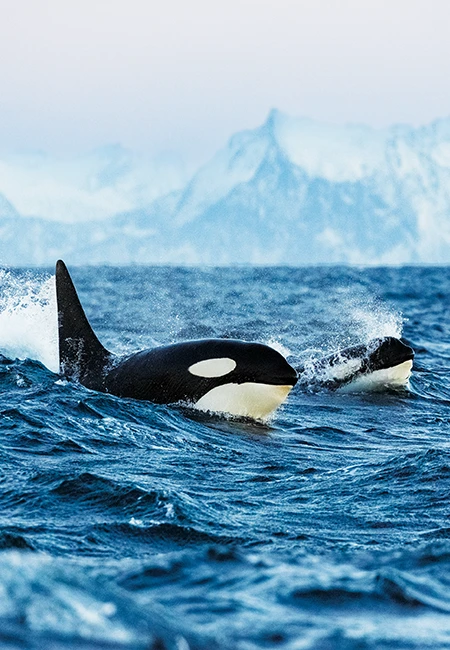
Approximately 3,000 orcas live in the greater Norwegian Sea–Barents Sea expanse that flanks the remote coastlines of extreme northern Europe and westernmost Russia. Scientists believe about half of these orcas — spekkhogger in the Norwegian language — call Norway’s waters home.
Many orcas pursue herring year-round, moving from offshore, open waters into the coastal fjords from October to January. They come in the company of their kin, organized into family pods usually numbering between 10 and 40 individuals.
While sometimes called killer whales, orcas are the largest member of the dolphin family. Males grow up to about 30 feet (9 meters) long and weigh more than 5 U.S. tons (4,536 kilograms). Females grow to nearly 26 feet (7.9 m) long. Their calves average just under 8 feet (2.4 m) long at birth. Males in the wild normally live 30 to 40 years. A female’s lifespan averages 50 years but can stretch to 80 or more.
While orcas come to feast on herring, the fish swim into the fjords to chill. Millions of tons of Norwegian spring-spawning herring (Clupea harengus) enter the narrow waterways and shallow bays that define the country’s western coastline to hunker down through the winter months. Their biological clocks tell them to wait here, massed together about 150 to 600 feet (46 to 183 m) below the surface, until it’s time to migrate south to procreate.
Herring that survive the orcas’ wintertime appetites in the northern fjords and the ensuing journey down the coast during February and March will spawn in spring between Bergen and Trondheim. Strong, clever, or lucky herring can live up to 25 years.
Cat and Mouse
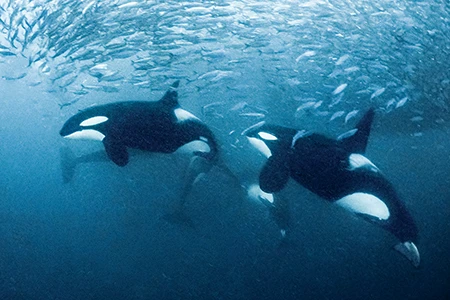
Orcas around the world utilize different hunting strategies depending on the specific prey, its abundance and behavior, and the characteristics of the environment in which predator and prey coexist. In Norway, orcas have perfected a unique, sophisticated, cooperative foraging method called carousel feeding, in which whales coordinate their efforts and work as a team.
They dive down and separate a group of herring from the larger school and then herd the isolated fish into a ball, moving them toward the surface or into an enclosed bay. The orcas stun the herring with powerful tail strikes, sometimes even performing acrobatic somersaults to incapacitate the fish with well-aimed fluke swipes. It’s game over for the immobilized prey.
The predator swoops in to dine casually, gracefully eating one hapless herring at a time. The nimbleness with which an orca can use only its lips, tongue, and teeth to effectively fillet the fish and then spit out the bones is undeniably impressive.
Norwegian spring-spawning herring is a superfood, rich in nutrients and high in fat and protein. Norwegian orcas consume 300 to 600 herring per day, amounting to 100 to 110 pounds (45 to 50 kg). They spend 40% to 60% of each day searching for food and eating — a major time commitment and fundamental part of their daily life and culture.
These super-intelligent cetaceans are highly social, living their entire lives together in tightly knit units organized around matriarchs. The pod is a multigenerational family made up of one or more grandmothers (and sometimes even great-grandmothers), their adult offspring, and their offspring.
This environment and culture cultivate strong, long-lasting bonds among podmates that facilitate the social transmission of knowledge and behaviors. Norway’s orcas are not born knowing how to carousel feed or where and when to travel to find the best food resources. They learn these vital life skills from their families.
About 1,400 individuals have been photo-identified in these waters over the past 40 years. The Norwegian Orca Survey team is at the epicenter of all things orca here. Researchers monitor population dynamics, investigate social behavior, measure contaminant levels, facilitate citizen science, promote conservation efforts, and study feeding ecology. One line of current research discovered that some orcas also occasionally dine on seals, harbor porpoises, and lumpfish.
History and Geography
Swimming with orcas in Norway through organized, commercially offered tours started in the early 1990s in the Tysfjord area of Lofoten, about 68 degrees north latitude. There was only one tour operator at the time.
I have been an orca enthusiast since childhood and desperately wanted to go. Unfortunately, I was denied that opportunity twice — first due to a freak storm and then a few years later for family reasons. When I was ready to try again a decade later, my quarry’s movement patterns had changed dramatically. Quality orca encounters were infrequent because prey and pursuing predators were now spread out over a huge area in more exposed waters. I waited and hoped.
In 2014 the herring changed things up again. For a few years, fish (and orcas) seemed content to overwinter in Andfjord, between Andøya and Senja Islands at approximately 69 degrees north latitude. Other photographers were creating new, spectacular pictures. Fear of missing out was strangling me at home.
I eventually booked two weeks in January 2017 and finally swam with orcas in the Arctic. I also fell in love with the harsh, eye-wateringly beautiful black, white, pastel pink, and indigo blue winter seascapes. In terms of my photographic work, however, the trip was a bust — only brief, albeit cherished, glimpses of whales and no real feeding events.
The bulk of the expected herring stocks did not appear in Andfjord that year. Consequently, orca numbers were very low. Without telling us, those little silvery super fish had deviated course to a new overwintering destination farther north, probably in response to warming seas.
Since 2018 the bullseye for Norway’s orca-watching industry has been Kvænangenfjord above the city of Tromsø. I have now made three trips totaling nine weeks to the small fishing town of Skjervoy, about 70 degrees north latitude. Skjervoy is ideally positioned on the massive fjord’s southern side and transforms every winter (at least for now) into a bustling hub of orca activity.
In Their Realm
I’m often asked what it’s like to swim with Norway’s orcas. A cavalier response would be, “Amazing, of course!” My truthful and more useful answer, however, is more complicated and requires lots of unpacking. This ongoing photo mission has been the most compelling, inspiring, frustrating, photographically challenging, and emotionally roller-coastering of my career. It’s difficult but worth it.
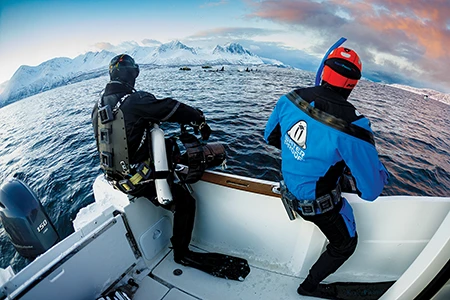
First, it’s really cold. Sea surface temperatures average about 43°F (6°C) in late October and 41°F (5°C) in December but dip lower near fjord heads. Air temperatures around Skjervoy range widely during orca season from about 10°F (–12°C) to 46°F (8°C).
I have used both drysuits and custom-fit, open-cell 7 mm wetsuits. Overall, I prefer the wetsuit for greater mobility in the water. Immersion for short periods isn’t the problem. It’s afterward when you’re topside, wet and exposed to the elements. Get out of the wind as soon as possible, bundle up in a fleece-lined robe, and keep your hands covered. Get your blood pumping by dancing around like no one’s watching.
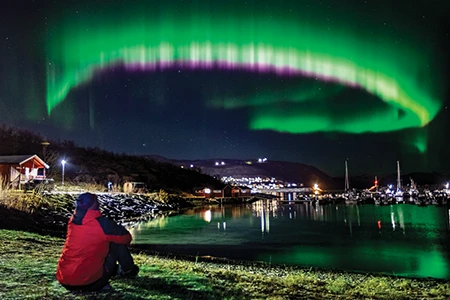
It’s also very dark. There are precious few daylight hours in Arctic winter. In late November the sun ceases to rise above the horizon for almost two months. The best you can hope for at that time is clear midday twilight. Throw in heavy clouds or snow flurries, and it’s very difficult to find and follow black-finned orcas in the same-colored seas.
Underwater photographers have only a few hours to work. This limited time window and the darkness beneath the surface present formidable challenges. Fast lenses (f/1.8 and f/2.8), slow shutter speeds, high ISOs (often 3200 and up), and cameras with sensors optimized for low-light performance are the best strategy. Technology — and luck — gives you a fighting chance.
There are also plenty of biological challenges, especially to witness the holy grail: orcas feeding on herring. The fish can be too deep for us to see while snorkeling, or they can be swimming too fast for even an Olympian to catch. Neither situation is an obstacle for orcas, but it certainly is for mere humans.
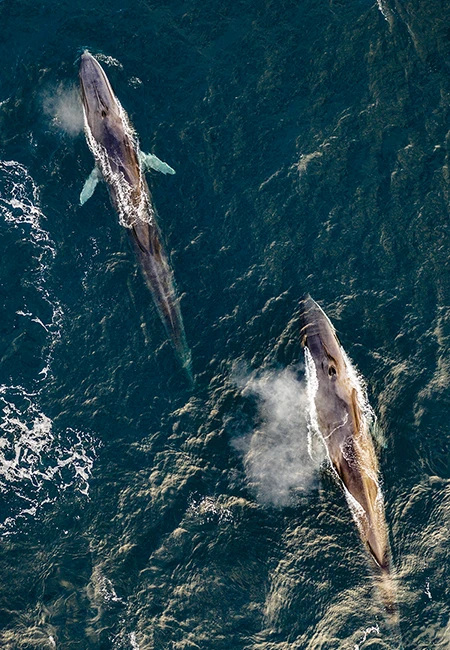
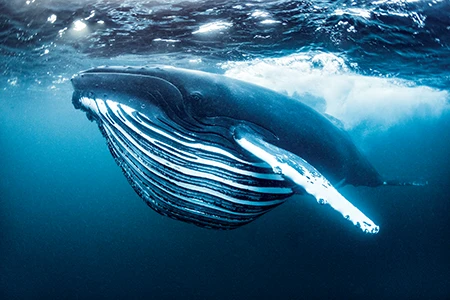
Humpback whales have also robbed me of the prize. It has become common for uninvited humpbacks to charge into a baitball right after orcas have rounded up fish and started their carousel feeding. In just one pass with its cavernous maw agape, a party-crashing baleen whale can scoop up hundreds of herring, obliterating the school and causing such chaos that the orcas simply give up and move on. Fin whales are now visiting the fjords to feed on herring, too.
It’s also frustrating when orcas are feeding close to active herring fishing boats. Tour operators are not allowed to approach closely or put swimmers into the water near these huge ships and their purse seine nets.
The Focus of Many
Norway’s orcas and the herring on which they depend find themselves in the middle of the commercial fishing industry and whale tourism. The nation’s herring harvest is big business. Global exports in 2024 alone were worth about 4.2 billion Norwegian krone (more than $430 million U.S.). The growing whale-watching fleet of liveaboards and day boats brings thousands of excited, expectant customers into the orcas’ realm. Both industries impact the environment.
Presently, the herring fishery is considered well-managed. Quotas are respected, and whales have plenty to eat. But commercial fishing has changed the orca’s natural feeding behavior. Some orcas now spend considerable time swimming around boats and under fishing nets, eating herring escapees as fishers retrieve nets and pump fish into the ship’s hold.
This newly adopted specialized feeding technique is quite different from carousel feeding. Boats, not cooperating orca family members, do the hard work trapping the fish. This introduces risks. One scientific study estimated that seine nets entangle 18 Norwegian orcas each year. Research into acoustic deterrent devices will hopefully yield a safe solution to deter orcas without reducing fish catches.
Quantifying how swimmers and whale-watching vessels affect orcas is no simple task. Norwegian Orca Survey has begun a study to discover how tourist activities may be altering orcas’ behavior. Should the number of boats be capped? Permits required? Are swimmers really harassing the orcas? Can the tourism industry develop effective guidelines and self-police to ensure ethical, sustainable tourism, or does the government need to draft and enforce official regulations to control tourism and ensure the animals’ welfare? These and other questions are on people’s minds, mine included.
I’m very fortunate to have met orcas in the wilds of Norway and privileged to have been afforded front-row views into their lives. I have experienced many life-enriching encounters: a playful juvenile squeaking and spiraling repeatedly around me, a family pod in formation gliding past me in the gloom, and a perfectly choreographed herring hunt during a blizzard in water so dark I gave up on my camera and just watched, awestruck.
These extraordinary creatures, and this place, have their hooks in me deeper than ever. I’m already planning the next body-torturing, soul-singing expedition.
Explore More
See more about Orcas in Norway in this video.
© Alert Diver – Q2 2026