Perception and Reality in Mouthpiece Retaining Strap Use
In the high-stakes world of closed-circuit rebreather (CCR) diving, the margin for error is notoriously thin. While this technology offers the seductive promise of silent, extended exploration, it carries a fatality rate between 1.8 and 3.8 deaths per 100,000 dives, which is significantly higher than open-circuit scuba.
When we look at the postmortem data, a chilling pattern emerges. Regardless of the initial trigger (hypoxia, hypercapnia, or oxygen toxicity), the final common pathway to death is almost always drowning following a loss of consciousness (LoC).
The mouthpiece retaining strap (MRS), colloquially known as a gag strap, was designed to break this fatal chain. Yet, as our international survey reveals, the tool remains one of the most contentious pieces of kit in the technical diving arsenal.
Data of Survival vs. Culture of Reluctance
The foundational evidence for the MRS comes from the French navy, which documented 54 cases of LoC underwater. In every instance where an MRS was used in a team diving setup, there were zero fatalities due to drowning following an LoC.
For a recreational community where drowning is the primary killer, this should be a smoking gun for safety standards, but our survey of 563 divers illustrates a stark divide. Despite the data, the MRS lacks widespread adoption. The reluctance isn’t just a matter of forgetting to buy a strap; it is rooted in a deep-seated perception of risk. Divers often view the MRS as a potential trap rather than a safety net.
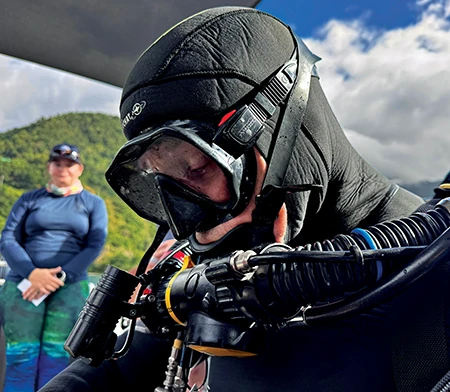
The primary psychological barrier the study identified is the fear of being strapped into a failing system. In a rebreather emergency, such as a caustic cocktail — when water enters the breathing loop and reacts with the carbon dioxide (CO2) absorbent to create a caustic solution — the diver’s immediate instinct and training is to spit out the mouthpiece. Critics of the MRS argue that in such a crisis the strap adds a layer of physical and cognitive friction that could delay a lifesaving transition to a bailout regulator.
Challenges and Perceived Dangers
To understand why some divers perceive the MRS as dangerous, we must look at the specific failure modes they fear most.
The most cited concern is how the MRS complicates the bailout procedure. If a diver needs to switch to an open-circuit regulator, they must first clear the strap. In a high-stress, high-CO2 (hypercapnic) state, fine motor skills deteriorate. Divers fear that the extra second required to slip the strap over their head or unclip it could be the difference between life and death.
The survey also touched on possible physical challenges.
• Gear interference: The strap can snag on hoods, mask straps, or helmet hardware.
• Comfort: While some divers think that the MRS relieves jaw fatigue, others find it restrictive or uncomfortable, leading to distraction that could compromise situational awareness.
• Caustic flood: The nightmare scenario for many is having a caustic solution held against their lips and gums by a strap they cannot immediately shed.
The Power of Training
Perhaps the most significant finding of our research is the correlation between formal training and the perceived value of the MRS. Divers with formal MRS training rated the strap’s importance at a median of 74 out of 100, compared with a median of only 49 for those without training. Training addresses the fear of the unknown. When a diver is taught how to correctly configure the strap — ensuring it is tight enough to maintain a seal but loose enough to be shucked in an instant — it becomes a tool rather than a trap.
Divers who have never practiced a bailout with an MRS assume it will be difficult. Those who incorporate the MRS into their standard safety drills and bailout practice find that the movement becomes fluid. If you can stay calm and remember your training, you will reduce the transition time to a negligible margin.
Trained Divers Feel Safer
The survey results suggest that training not only teaches how but also validates why.
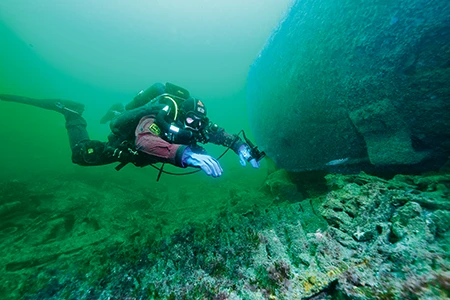
Trained divers are more likely to acknowledge the reality of an LoC. A diver without an MRS who loses consciousness will drop the mouthpiece and drown within 60 to 90 seconds. A diver with an MRS stays on the loop. Even if the gas in the loop is bad, the lack of water in the lungs provides a rescue window, allowing a buddy to intervene.
Untrained divers often use the strap incorrectly by pulling it too tight or using an ill-fitting design. These mistakes lead to a negative first impression. Formal training introduces standardized equipment and proper adjustment techniques, which eliminate the physical discomfort that often masquerades as a safety concern.
Roles of Manufacturers and Agencies
The survey highlights a gap in the industry. Not all manufacturers provide an MRS, and not all training agencies incorporate it into their standards, despite recommendations by the Rebreather Forum 4 and the Rebreather Training Council. This lack of standardization contributes to perceptions that the MRS is optional or experimental.
If we treated the MRS with the same cultural ubiquity as a seatbelt and viewed it as a standard and practiced safety requirement, the perceived danger would likely evaporate. For this shift to occur, the industry must move past the current hardware limitations that fuel diver skepticism.
Our findings suggest that if manufacturers integrated the MRS into the primary mouthpiece design, ensuring both compatibility and ease of release, the barrier to entry would be lowered significantly.
The lack of ergonomic diversity in existing MRS options is a significant hurdle. Many straps are manufactured as single-block units, which forces the diver to use a specific, proprietary mouthpiece, thus ignoring physiological differences among the dive community. A mouthpiece and strap assembly designed to fit the jaw of a large, heavy diver, for example, is often functionally unusable and potentially painful for a small, thin person.
When a diver must choose between a lifesaving strap and a mouthpiece that causes jaw fatigue or a poor seal, comfort often wins over safety. For the MRS to become a global standard, it must accommodate a wide array of interchangeable, medical-grade silicone mouthpieces that respect the anatomical differences in dental arches and jaw widths.
The effectiveness of the MRS is predicated on its ability to maintain a watertight seal during an LoC. A strap that merely keeps the mouthpiece in the vicinity of the mouth is insufficient; the system must include an effective lip cover that is held firmly against the perioral tissue. Without a proper seal, the diver may still aspirate water around the edges of the mouthpiece, even if it remains in place. The challenge for designers is to create a lip cover that is soft enough to conform to various facial structures yet firm enough under the tension of the strap to prevent ingress.
The mechanism of removal is also central to the perception of feeling trapped. Rigid or complex clipping systems can be intimidating, especially when imagining a high-stress bailout scenario.
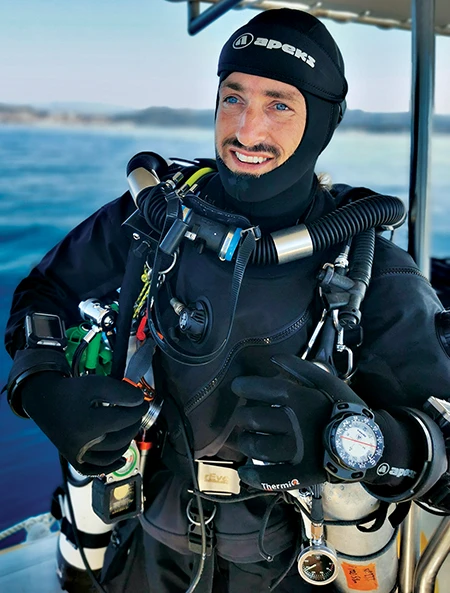
Our study highlights a growing preference for elasticized tension systems. Unlike fixed straps that require manual unclipping or dexterity-intensive manipulation, elastic MRS designs allow the diver to simply pull the mouthpiece forward and clear it from the jaw in one fluid motion. This elasticity provides a dual benefit: It maintains enough tension to provide an effective seal of the lip cover against the face during an LoC, yet it offers a fail-safe path for immediate removal without the need for fine motor skills.
By prioritizing these intuitive, elastic designs and customizable, sealing components, manufacturers can transform the MRS from a perceived hindrance into a seamless extension of the diver’s life-support system.
A New Safety Culture
The results of our MRS survey point to a clear path forward. The challenges — interference with bailout, fear of entrapment, and physical discomfort — are real, but they are largely perceptual rather than inherent.
The data are clear: The MRS saves lives by buying time for a buddy to perform a rescue. The reluctance to use it is a human factors issue, not a technical one. To lower the feeling of danger, the community must move away from anecdotal debates on forums and toward structured, evidence-based training.
By integrating the MRS into the beginning of the CCR certification process, we can change the narrative. We can move from a culture that fears the strap to one that recognizes it as a vital line of defense against the most common cause of death in our sport.
The MRS may pose some challenges, but they are not insurmountable and do not justify foregoing additional protection against a preventable drowning. For many divers, the MRS is truly a lifeline.
© Alert Diver – Q2 2026