FOOD SaFETY

Trying new and different cuisines is an exciting and enjoyable aspect of traveling. In certain parts of the world, however, both eating and drinking may carry considerable health risks.
General Recommendations
Figure 5 presents the CDC’s guidance regarding what’s safe to eat and drink — and what’s not. Table 8 provides the U.S. Peace Corps recommendations.
Seafood Safety
Many natural toxins in seafood can cause seafood poisoning. Such toxicity can be inherent to a species, such as with the Japanese pufferfish known as fugu, or can result from external contamination, such as the neurotoxin ciguatera. Gastrointestinal problems attributed to seafood poisoning, however, often are the result of infections caused by ingesting harmful bacteria, parasites or viruses. For more information on these disease agents, see Managing Travel-Related Illnesses earlier in this section.
Ichthyosarcotoxism is a form of food poisoning resulting from the ingestion of fish flesh containing natural toxins. Ichthyosarcotoxism is derived from the Greek words ichthyo (meaning “fish”), sarx (“flesh”) and toxism (“intoxication” or “poisoning”). The three main ichthyosarcotoxisms are ciguatera, scombroid fish poisoning and tetrodotoxism.
Ciguatera:Microscopic reef organisms produce a neurotoxin that causes ciguatera. Small fish feed on these organisms, and bigger fish eat the small fish. The bigger the fish, the more toxic the meat. Large predators such as barracudas, eels and groupers contain more toxins due to food-chain bioaccumulation. Symptoms are primarily neurological, such as numbness, tingling and dizziness; gastrointestinal symptoms such as nausea, vomiting and diarrhea may also occur. Symptoms can last for a few days or may persist for months or even years but are rarely fatal. Infected fish appears, smells and tastes normal — it has no unusually fishy odor. Cooking does not diminish the potency of the toxin, so travelers should avoid eating large reef-based predators. For more information on ciguatera, see DAN.org/ciguatera.
Scombroid poisoning: The scombroid family of fish includes tuna, mackerel, mahi-mahi and jack. Scombroid poisoning is caused by eating any of these fish that have not been properly refrigerated after being caught. Once such a fish is dead, bacteria that is naturally present in its gut translocate and break down a component of the meat, releasing an immune-system compound called a histamine. Ingestion of large quantities of histamine-contaminated meat triggers an allergic-like reaction. Scombroid poisoning can easily be confused with and misdiagnosed as a seafood allergy. Contaminated fish looks, smells and tastes normal — perhaps with a slight peppery or metallic taste but not unpleasant or foul. Cooking does not eliminate histamines and will not prevent symptom occurrence. While traveling, avoid eating these kinds of fish unless you are sure it was properly chilled immediately after being caught and then kept at a temperature below 40°F (4.4°C) until it was cooked. For more information on scombroid poisoning, see DAN.org/scombroid.
Pufferfish poisoning: Pufferfish poisoning, also known as tetrodotoxism (TTX), is caused by eating a highly potent neurotoxin contained in certain fish — such as pufferfish, triggerfish, mola mola and Japanese fugu — from the order Tetraodontiformes. Initial symptoms usually involve numbness around the mouth shortly after ingestion. TTX can be deadly because it leads to progressive systemic paralysis, which can result in respiratory failure. Cooking does not alter the potency of the toxin, so travelers should avoid eating these fish in any form or preparation.
Shellfish such as mussels, clams, oysters and scallops can also cause various forms of seafood poisoning. These are bivalve mollusks (with a two-part shell) and not fish, however, so such poisonings are not considered ichthyosarcotoxisms. For more information on shellfish poisoning, see DAN.org/redtide.
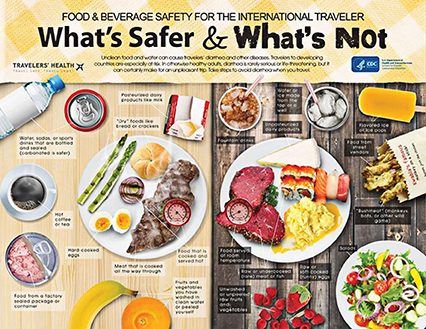
Figure 5.
CDC Food and Beverage Safety
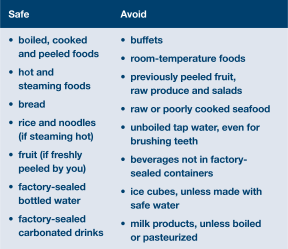
Table 8.
U.S. Peace Corps
Recommendations for
Food Safety
DAN Customer Service
Mon–Fri, 8:30 a.m. – 5 p.m. ET
+1 (919) 684-2948
+1 (800) 446-2671
Fax: +1 (919) 490-6630
Email: Member@DAN.org
24/7 Emergency Hotline
In event of a dive accident or injury, call local EMS first, then call DAN.
24/7 Emergency Hotline:
+1 (919) 684-9111
(Collect calls accepted)
DAN must arrange transportation for covered emergency medical evacuation fees to be paid.
Medical Information Line
Get answers to your nonemergency health and diving questions.
Mon–Fri, 8:30 a.m. – 5 p.m. ET
+1 (919) 684-2948, Option 4
Online: Ask A Medic
(Allow 24-48 hours for a response.)