Seven Marine Species on the Brink
Nearly 6,000 marine species are in serious trouble, with 237 designated as critically endangered by the International Union for Conservation of Nature (IUCN). The loss of any animal ripples through its entire ecosystem; with so many species at risk, our oceans could change drastically in the coming years.
The eight species highlighted here are recognized as at risk by the IUCN, the U.S. Endangered Species Act (ESA), or the Convention on International Trade in Endangered Species of Wild Fauna and Flora (CITES), which regulates trade. This article explores why these animals are essential, the threats they face, and the efforts to save them.
The IUCN Red List of Threatened Species categorizes risk levels as follows: Extinct, Extinct in the Wild, Critically Endangered, Endangered, Vulnerable, Near Threatened, Least Concern, Data Deficient, or Not Evaluated.
Humphead or Napoleon Wrasses (Cheilinus undulatus)
IUCN Endangered, CITES Appendix II
Named for a forehead bump resembling French Emperor Napoleon’s two-pointed hat, Napoleon wrasses are some of the largest fish around coral reefs, reaching lengths of 6 feet (1.8 meters) and weights up to 400 pounds (181 kilograms). Juveniles are white with dark scale bars and black lines near their eyes but change to blue-green or brilliant purplish-blue as adults. Color isn’t all they change — females can transition to males later in life.
As one of the few species known to eat toxic crown-of-thorns starfish, Napoleon wrasses help maintain coral reef health. These fish live for up to 30 years but have a slow breeding rate. Collection for the live aquarium trade in Southeast Asia — often through destructive practices — and reef degradation have reduced their numbers by as much as 50%.
The U.N. Food and Agriculture Organization recommends protecting this species by establishing marine protected areas and restricting exports. Data show those measures work. Yvonne Sadovy, a marine biologist at the University of Hong Kong, reports high numbers of the fish in the Tubbataha Reefs Natural Park protected area in the Philippines and large individuals in regions that do not allow exporting, such as Palau and the Maldives.
These fish live in the Southwest Pacific Ocean, Indonesia, and the Indian Ocean.
How to help:
- Avoid buying or consuming these fish.
- Support local dive operations as alternatives to the aquarium trade.
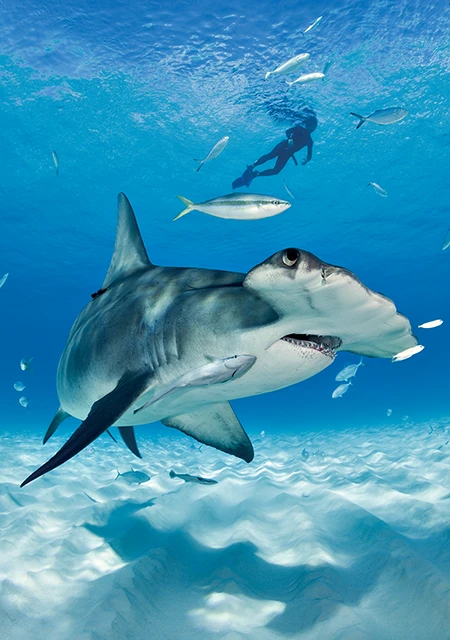
Great Hammerhead Sharks (Sphyrna mokarran)
IUCN Critically Endangered, CITES Appendix II
Great hammerheads reach lengths of 20 feet (6 m) and weigh up to 1,000 pounds (454 kg). Stingrays are their preferred prey, and the sharks use small pores on their heads to detect electrical signals that rays emit while buried in the sand. Female hammerheads can have litters of six to more than 50 live pups.
Scientists at Nova Southeastern University in Florida estimated in 2006 that fins from more than 73 million sharks of all species are sold globally every year. Other research estimates that about 400,000 and perhaps as many as 1.15 million great hammerheads are killed annually for their fins.
“We published that study some time ago,” said Mahmood Shivji, a professor at the university. “There is no telling what the numbers are now. Some countries have stepped up protection, including the U.S., but it is hard to say what impact that has had globally.”
The U.S. prohibits shark finning and the import and sale of fins, but conservation organizations say the practice continues in many countries. Hammerheads are also discarded as bycatch and targeted by recreational anglers, and they seldom survive catch-and-release fishing.
Hammerheads live in tropical seas worldwide and migrate thousands of miles through the open ocean.
How to help:
- Support shark-focused dive operations like those in the Bahamas as an alternative to fishing for them.
- Support WildAid’s campaign discouraging consumption of shark fins at wildaid.org/donate.
- Support stricter enforcement of the U.S. ban on the import and sale of shark fins.
Sicklefin Devil Rays (Mobula tarapacana)
IUCN Critically Endangered, CITES Appendix I
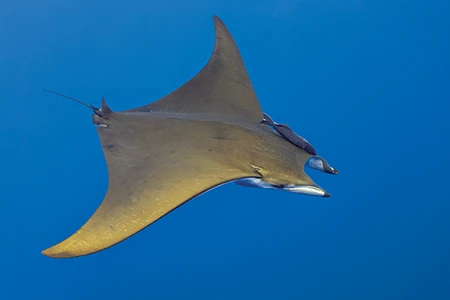
Named for the pronounced ridge along their dorsal midline, sicklefin devil rays are olive green or brown on top and gray and white underneath. They dive deeper than other rays, down to 6,000 feet (1.83 km), and may play a critical role in connecting surface and deep-sea ecosystems. All ray species are important to the overall health of oceans.
Sicklefin devil rays are traded for their recognizable black-and-white gill plates. Manta and devil rays are eaten in at least 35 countries and exported from 10, according to research by an international group of scientists, including those from the Manta Trust. Additional data collection showed that fishers in at least 43 countries land rays, and those in 13 other countries discard them as bycatch.
This widespread consumption surprised scientists and shows a need for stronger regulation and enforcement. The researchers noted 14 priority countries where action is most needed, including dive destinations Indonesia, the Philippines, and Thailand.
Researchers are using satellite tagging around seamounts in the Azores to learn more about sicklefin ray movements and how sea temperature changes affect them.
These rays live throughout the tropics and in warm, temperate seas.
How to help:
- Avoid consuming devil ray meat.
- Donate to support Manta Trust’s research at mantatrust.org.
- Contribute to Manta Trust’s Mantabase photo database at mantabase.org.
Olive Ridley Sea Turtles (Lepidochelys olivacea)
IUCN Vulnerable, CITES Appendix I, ESA Threatened, ESA Endangered (Mexico Pacific Coast population)
These sea turtles are among the smallest, at about 2.5 feet (76 centimeters) long and 85 pounds (38.6 kg) on average. The olive ridley’s varied diet includes algae, crustaceans, fish, and mollusks, and they can dive as deep as 500 feet (152 m) to forage.
Threats to these animals include direct harvest, bycatch, habitat degradation, and the collection of eggs and turtles on nesting beaches. Tagging research shows that these sea turtles swim hundreds to thousands of miles along varying pathways, putting them at risk from fishing activity.
Thousands of females often nest together on the same beach in what are known as arribadas (arrivals), and conservation efforts have focused on protecting these beaches in Mexico and Costa Rica. The turtles’ IUCN status report, however, indicated significant declines on hundreds of solitary-nesting beaches from Mexico to Ecuador, observed retired Texas A&M University oceanography professor Pam Plotkin.
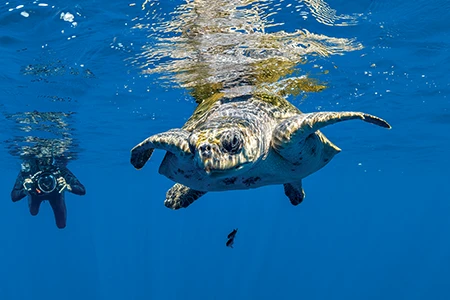
“The idea has persisted that olive ridleys mainly nest in large aggregations,” Plotkin said. “But there are hundreds of thousands of solitary nesters, and they are widely distributed.”
Olive ridleys live in the tropical Atlantic Ocean, the Pacific and Indian oceans, Mexico’s Gulf of California, and the Caribbean.
How to help:
- Use resources such as the Monterey Bay Aquarium Seafood Watch (seafoodwatch.org) or the Marine Stewardship Council certification (msc.org) to choose sustainable seafood.
- Support conservation by symbolically adopting an olive ridley at conserveturtles.org/adopt-a-turtle.
Galápagos Penguins (Spheniscus mendiculus)
IUCN Endangered
This species is one of the smallest penguins in the world, at about 5 pounds (2.3 kg) and 19 inches (48 cm), and is endemic to the Galápagos Islands. They live farther north than any other penguins and have developed techniques to stay cool, including nesting in caves or volcanic hollows.
These marine birds are agile underwater and can swim as fast as 20 miles (32 km) per hour. They primarily eat schooling fish, such as anchovies and sardines, that thrive in the chilly Humboldt Current flowing through the archipelago. The penguins are prey for snakes, owls, and hawks on land and for sharks and sea lions at sea.
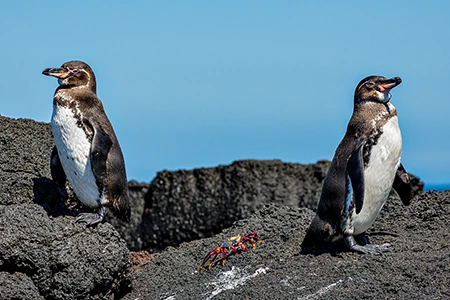
Threats include fishing bycatch and El Niño events that warm the sea and reduce their prey fish populations. Galápagos penguins also become entangled in fishing gear and ingest plastic fragments. The Galápagos Conservation Trust (GCT) and partners, including the Galápagos National Park Directorate, remove more than 8 tons (7.26 metric tons) of plastic pollution from island beaches each year, but clean-up is a short-term fix.
“We will overcome this problem only by tackling long-term, systemic issues driving the plastic influx,” said GCT communications manager Tom O’Hara.
How to help:
- Support plastic removal by donating at galapagosconservation.org.uk/our-work/projects/plastic-pollution-free-galapagos.
- When visiting the Islands, bring reusable water bottles and shopping bags, avoid single-use plastic items, and take home as much of your trash as possible. Don’t bring toiletries containing plastic microbeads.
Hawaiian Monk Seals (Neomonachus schauinslandi)
CITES Appendix I, ESA Endangered
Hawaiian monk seals range throughout the archipelago, from the main Hawaiian Islands northwest to Papahānaumokuākea Marine National Monument.
The seals forage at or near the seafloor and eat a wide variety of foods, including fish, squid, octopus, and crustaceans. These marine mammals can hold their breath for 20 minutes and dive deeper than 1,800 feet (549 m) but typically dive for about six minutes to less than 200 feet (61 m).
Hunted almost to extinction in the 1800s, the population recovered in the early 1900s but began to decline in the 1950s due to limited food availability, entanglement, habitat loss, and other factors. The current population is estimated at 1,600, and they still face threats, including entanglement in marine debris and fishing gear, habitat loss, and human interaction, including intentional killings.
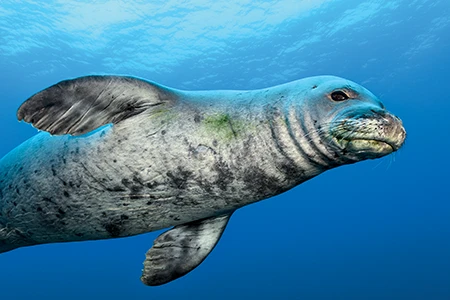
Hawaiian monk seals spend two-thirds of their time at sea and haul out on beaches to rest and molt.
How to help:
- Report stranded, injured, or entangled seals at fisheries.noaa.gov/report or call 1-888-256-9840.
- Keep a distance of at least 50 feet (15 m) from seals on the beach, and keep dogs on a leash.
- Support removal of ghost fishing gear from the ocean at oceanconservancy.org/work/biodiversity/global-ghost-gear-initiative.
- Report debris in the water or on the shore in Hawai‘i to 833-4-DA-NETS (833-432-6387).
Blue Whales (Balaenoptera musculus)
IUCN Endangered, ESA Endangered
Blue whales are the largest animals to have ever existed on Earth, growing up to 110 feet (34 m) long and weighing up to 165 tons (150 metric tons), with hearts the size of a small car. They are among the planet’s loudest creatures too and are able to hear each other over almost 1,000 miles (1,609 km) with the right conditions.
These animals cycle nutrients from ocean depths to the surface and into nutrient-poor areas. This process supports the growth of phytoplankton, microscopic organisms that form the base of the marine food chain and produce roughly half of Earth’s oxygen. Dead whales sink to the depths and nourish deep-sea organisms.
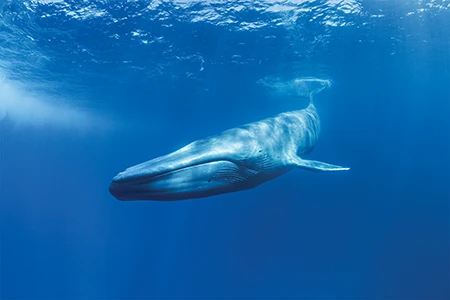
Threats to this species include entanglement, habitat degradation, and ship strikes. Ships kill an estimated 80 whales off the U.S. West Coast each year, with about 18 of them blue whales, said Jess Morten of the California Marine Sanctuary Foundation. That may be just the tip of the iceberg, as most strikes at sea are not noticed, and the dead whales sink.
Slower ship speeds significantly reduce the likelihood of a strike being fatal and lower emissions from ships, reducing coastal air pollution. The National Oceanic and Atmospheric Administration (NOAA) instituted voluntary speed reductions on the U.S. West Coast in 2007, and the Protecting Blue Whales and Blue Skies collaborative partnership formed in 2014 to encourage industry participation.
“We collect data on where ships are traveling and how fast,” said Morten, whose organization is involved in the program. Companies receive public recognition for compliance, which she said has bumped participation from 20% to around 70% in California.
Blue whales live in all oceans except the Arctic.
How to help:
- Help ships avoid whales by sharing real-time sightings at fisheries.noaa.gov/resource/tool-app/whale-alert.
- Encourage companies to support slower ship speeds as a Protecting Blue Whales and Blue Skies ambassador, bluewhalesblueskies.org/ambassador-program/join.
- Report stranded or entangled whales at fisheries.noaa.gov/report or download the Dolphin and Whale 911 app on your mobile device.
For more information about protected species, visit IUCN at iucn.org, CITES at cites.org, and the U.S. ESA at
fws.gov/law/endangered-species-act.
Explore More
Learn more about sicklefin devil rays and great hammerhead sharks in these videos.
© Alert Diver – Q1 2026