Cardiac emergencies can happen anywhere, often without warning, and survival depends on what happens in the first few minutes. Immediate recognition and activation of emergency medical services (EMS), high-quality CPR, and early defibrillation are critical links in the chain of survival.
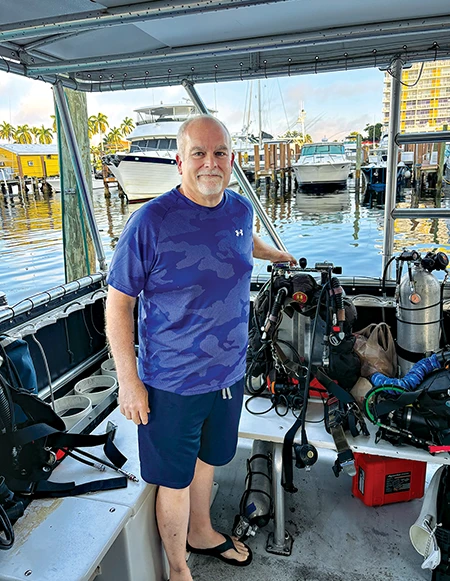
A rescuer demonstrated those links at last year’s Diving Equipment and Marketing Association (DEMA) Show in Orlando, Florida, when attendee Steve Corbin experienced a sudden cardiac arrest on the exhibit floor. Dean Zerbe, a newly certified DAN Examiner and former paramedic, was nearby and stepped in to help. Other trained bystanders who assisted include Cathy Sytsma, Laura Checkley, Francisca Joseph, and Pam Hodder.
Corbin and Zerbe share their perspectives on what happened.
Steve, please tell us what happened that day at DEMA.
SC: It was Friday, Nov. 14, 2025. I had been working from home, but I decided to go to the show around noon to meet some friends. I was running late, so I hustled to the venue and walked to my friend’s booth on the exhibit floor. There were no signs of anything wrong with me.
When I got to his booth, a person there said my friend was not at the show that day. I thanked him, shook his hand, and then felt a rush of warmth over me. That was the last thing I remembered before waking up in the ambulance.
Dean, where were you when the incident occurred? What first caught your attention?
DZ: I was visiting a travel booth at the DEMA Show with my business partner. Initially, I had my back to the incident. I heard a commotion, and my partner directed my attention to the scene.
What did you do when you reached the scene?
DZ: I walked over and noticed an older adult male on his back on the floor, with three people assisting him. I saw two or three people on their phones yelling, “Start CPR,” and the woman closest to me was on the phone with EMS. I asked my business partner to go get oxygen and an automated external defibrillator (AED).
People on scene were trying to move him into a left lateral position, but I noted that his breathing was abnormal and appeared to be agonal, with irregular, growling respirations.
We immediately returned him to his back. One woman checked for a pulse and said there was none. I checked and confirmed there was not
a pulse.
I remember telling the three other people on the floor, “OK, let’s do this.” During the first few compressions, I felt the uncomfortable but familiar sensation of ribs giving way. I went through an unknown number of rounds before another person took over the airway. I was starting to get tired when I heard a woman say she could take over, so at the end of that round I turned compressions over to her.
Shortly afterward, an AED arrived. We attached the pads, analyzed the rhythm, and delivered a shock before resuming CPR. After a few more rounds, the person started breathing. An emergency medical technician (EMT) from the convention arrived with oxygen and placed a non-rebreather mask on the man. A woman confirmed he had a pulse and started gently shaking the man. He eventually began to talk.
I stepped back from the scene and only then noticed the large crowd that had gathered. From that point, I was just another observer. I saw the man sitting up on the gurney and talking to the EMS crew as they were taking him to the ambulance.
Steve, were you aware of anyone assessing you?
SC: I was unconscious. My awareness didn’t return until I was in the ambulance.
When you regained consciousness, what was the first thing you noticed?
SC: I was in the ambulance, and the paramedic told me I was being taken to the hospital. My cellphone rang, and it was my son. The paramedic answered and told him what happened, which is when I became aware of the severity of my condition.
What was recovery like following the incident?
SC: I was transferred to Orlando Regional Medical Center on Nov. 16 to repair a left anterior descending (LAD) artery blockage, which required surgery to restore normal blood flow. The treatment included a coronary artery bypass grafting (CABG) to reroute blood flow using the mammary artery.
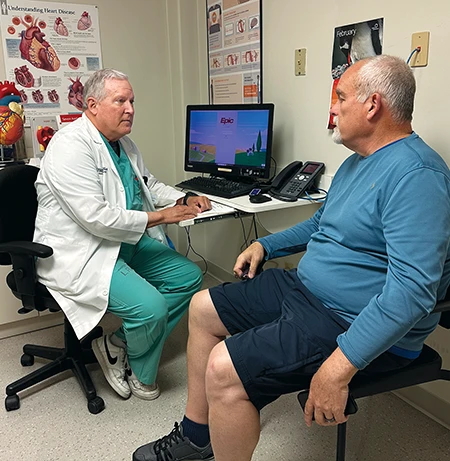
I spent nine days in the hospital. Within hours after the surgery, I was sitting up and later walking. Upon release, I began walking regularly and gradually increasing my activity. About five weeks after returning home, I joined the local gym and started physical therapy with Orlando Health three times a week.
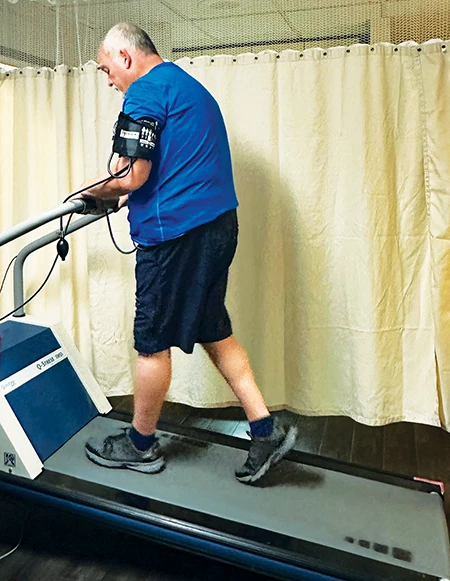
Under the supervision of Dr. Doug Ebersole, I performed the Bruce protocol stress test to evaluate my heart function as a step toward returning to diving.
Dean, how did this incident affect you?
DZ: I worked as a paramedic in California in the 1990s and early 2000s. I ran many codes, and only one person survived. I was prepared for this man not to survive. I was not prepared to see him talking to the EMS crew while leaving. That created an unexpected emotional response in me.
Steve, what does it mean to you knowing that trained responders were nearby and acted quickly?
SC: I was blessed to be at DEMA around people who were ready to act. I have lived my life by a motto that I learned from my military service and technical dive training: “Train for not if it is going to happen but when it is going to happen.” I encourage everyone to get trained and certified, as you never know when you will need those skills.
Dean, did this change or reinforce how you feel about your training and preparedness?
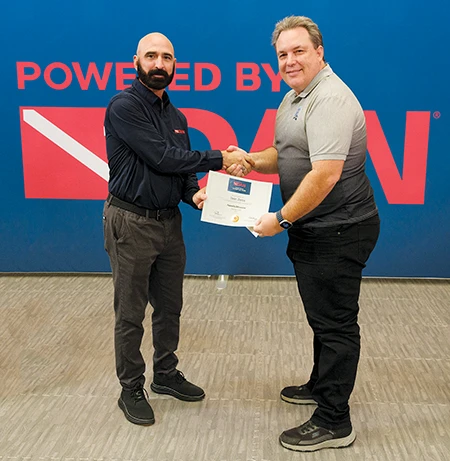
DZ: This emphasized the importance of early AED access and reinforced the need to teach the skill. My association with DAN as a newly minted Examiner as part of the Powered By DAN program with Scuba Educators helps to spread this skill to others.
Looking back, what stands out most to you about that day?
SC: This was a potentially fatal event, but I was at the right place at the right time and with the right people who had the right training, experience, and willingness to step up and save a life. I have won the biggest lottery in the world and will never forget it.
DZ: The most striking thing is how normal the day was and then seeing how a group of people with common training can pull together to make a difference.
As Corbin and Zerbe described, that day started as a normal day for both of them. First aid training is critical, not only in diving but also in everyday life, because emergencies can happen anywhere and at any time, even on a normal day.
© Alert Diver – Q2 2026