Working as an Underwater Stunt Performer
Working on a film set is unlike anything I had imagined. It’s a world of organized chaos and people moving with purpose, each absorbed in their own task.
Keyboards click, lenses change, grips lock diffusion frames into place, and the sound of drilling hums in the distance. People pace up and down the set while on their phones. Stunt coordinators review choreography. Makeup artists blend foundation under hot lights, while stylists swarm in with brushes for final touch-ups. Everywhere you look, something is happening.
Then a voice cuts through the buzz: “Quiet on set. Rolling!” Suddenly, everything softens and slows. Chatter fades away. The actors take their mark, and silence settles. And then just as quickly a voice interrupts, “Cut! We need to relight and reset. There is no feed to the screens.”
The crew is like a well-oiled machine, and the hustle returns. Every department is its own universe, and everyone is an expert in their craft. Stunt performers specializing in water skills are one piece of a bigger picture. Hours of rehearsal collapse into seconds of precision. Whether the action is scripted or improvised, the expectation to perform is the same.
This work requires three specific skill sets: learning to double an actor and perform the stunts in front of the camera, training actors in breath-hold or scuba diving, and being a safety diver while actors perform their own stunts.
Communication is vital and goes beyond the gestures and other underwater signals we commonly use as divers. There are typically underwater communication units to make it easy for the director topside to communicate with us below the water. They can call for us to move position or give other directions and call out action, but the intuitive understanding between the members of the underwater team makes the magic happen. It is easy when you are on scuba in 90°F (32°C) water, but communication becomes more crucial when you are on breath-hold and time is limited.
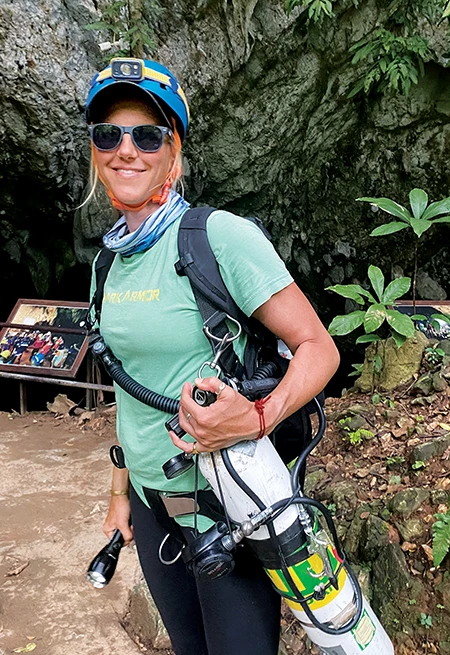
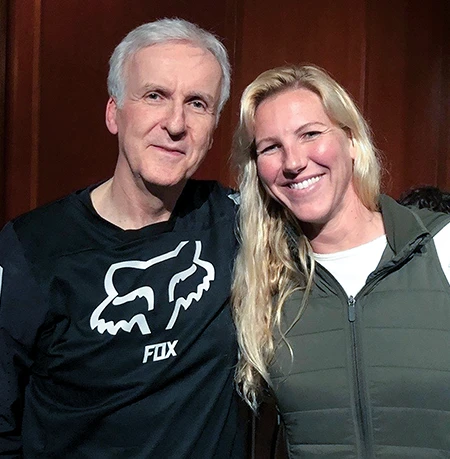
I joined the production for Avatar: The Way of Water in 2018, and the experience forever changed me. I learned to be part of a team and to trust those around me, and I discovered what it takes to bring the art of filmmaking to the big screen.
I was with the same group of people for months and had the opportunity to learn how everybody worked in the water. I knew that someone would be there to help if the slightest thing changed or if we had to adapt the action in a moment.
On other projects, however, I might work with people I have never met and may never work with again. Everyone on set is professional, no matter the situation. Stunt performers are expected to push the boundaries, so that’s an implied part of the job description.
While most of the work I do relies heavily on breath-hold, I occasionally work on a scuba-based film. Netflix’s mini-series Thai Cave Rescue was based on the 2018 rescue of the Thai youth soccer team trapped for more than two weeks in Tham Luang Cave, Chiang Rai Providence, Thailand. Three years after that event I was on location in Thailand, training actors to scuba dive. Two of the Thai actors also learned to breath-hold for the six-part series.
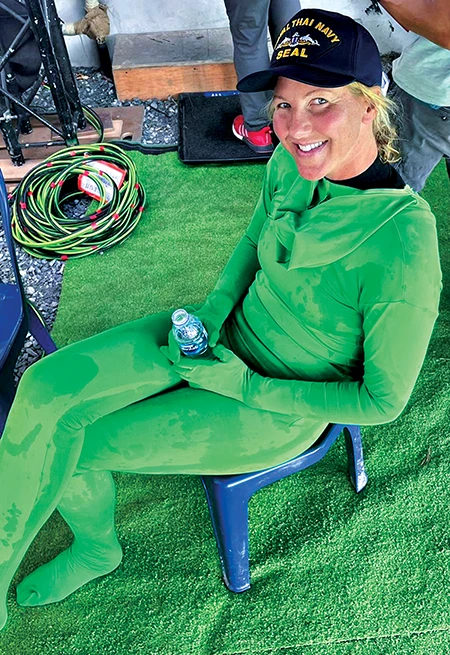
We shot in Tham Luang and on set in Bangkok, where I was the primary trainer and safety diver. Sometimes I would have to wear a green suit so I could help an actor and then be edited out of the scene in postproduction.
The part of the job I most enjoy is working closely with actors to take them through the necessary training, help them work through their action, and observe how they perform. Sometimes we watch them fall in love with the water and pursue more training.
Consistently working on my own dive skills is an important aspect of the job. You never know when you will get a call and need to travel somewhere. Having grown up as a competitive swimmer, I have always enjoyed fitness, but it’s also a requirement for stunt performers.
The core group of people I work with does not change much. There is something comforting about receiving your call sheet and recognizing the names of the people you will be working with the next day.
In some ways the crew is like an iceberg, as the audience sees only the final product — the small bit poking out of the ocean. Dive under the surface, however, and you will see the rest of the floating mountain — the platform that supports everything it took to get to the final cut.
The best piece of advice I received when becoming a stunt performer for films came from a friend and director of photography. He told me to observe everyone I work with and educate myself on what they do.
You can learn to anticipate a lens change and understand how it affects the shot and lighting. Comprehending a costume change on a breath-hold shot will help you know if it is likely to drag you under or float above your head. Knowing why the rigging changes and how that will affect your head position and final mark in the shot helps you be in the right place. You are a part of a team, but your responsibility is to be dependable and reliable.
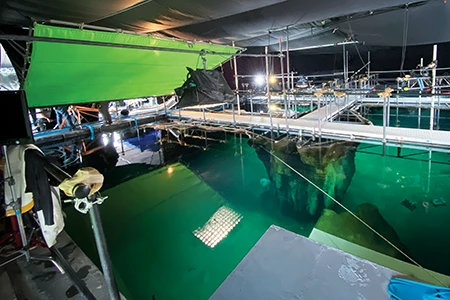
Stunts have given me more than a career — they’ve given me a community, a purpose, and an office made of water. I have known since childhood that being in the water is my happy place, and now it’s where I work.
The next time you watch a film, don’t leave when the credits roll. Stay to watch the names and job descriptions. Every one of those people has contributed their own little piece of magic.
How To Get Into Hollywood
There are several ways to break into the world of Hollywood. The most traditional is pursuing directing, acting, cinematography, writing, or other interests through a college degree. That route gives you exposure to many different departments and can lead to internships and assistant positions in the field. You can work your way up the ladder over time.
A lot of stunt performers were once gymnasts, martial artists, or track-and-field or motocross athletes. My path to the stunt world was through swimming, freediving, and scuba diving. I swam competitively when I was young and traveled the world for my career, gaining experience and certifications in scuba and freediving.
I am currently a PADI Instructor Development Course (IDC) staff instructor and freediving instructor trainer with full cave and technical certifications. It took me a long time to gain the experience and confidence to be reliable in my job. The work we do has to be second nature, and in moments of high stress you may have to make a decision that affects many people. I draw from past experiences all the time.
Having experience and certifications is one thing,
but having the opportunity to showcase yourself is another. I was fortunate to get an on-camera opportunity, which gave me membership in the Screen Actors Guild–American Federation of Television and Radio Artists (SAG-AFTRA).
Each department in filmmaking is attached to a union, and these unions are the backbone of Hollywood. Acting and stunts fall under the umbrella of SAG-AFTRA. You do not have to be in the union, but any production that is union-affiliated requires membership to work on it.
SAG-AFTRA has given me the chance to work on incredible projects. A few recent jobs have exposed me to the world of prosthetics and special-effects makeup. I took these jobs on a stunt contract but received acting credit for them. Being transformed into a creature and learning how to work, swim, and move in incredible suits and makeup is a lot of fun.
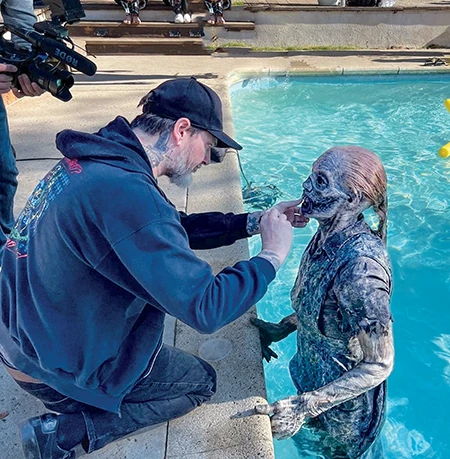
The first time I became a creature was in the thriller Night Swim as Boney Woman, who looked like she had come back from the dead. The team that worked every night to bring her to life was tremendous. The support I received from the stunt department and special-effects makeup artists proved what a team effort filmmaking is.
Hollywood is a world of art, science, technology, and imagination. It is filled with the most extraordinary people from all walks of life who bring together their passion and talents to entertain the world. It is also a challenging and competitive vocation. But there really is nothing like being in the spot when you hear, “Action!”
Explore More
Learn more about Parkinson in The DANcast episode and video linked below.
© Alert Diver – Q2 2026