I had dreamed of diving since I was a young boy. I watched underwater documentaries and imagined what it would feel like to float above corals and breathe calmly in a silent blue world.
My wife and I had never dived before, but we decided to learn together in Bali, Indonesia. I was excited, but I also wanted to be responsible, so I bought DAN dive accident insurance through the dive school before the trip. I hoped it would not be necessary, but it was.
We signed up for a three-day basic open-water certification program. Day one was training in a pool and practicing skills from the online learning materials. The second day was our first open-water dive at Padang Bai. We were scheduled for another open-water dive on the third day at the Liberty shipwreck off Tulamben, but unfortunately we didn’t get that far.
The pool session was a great start. It was fun and quickly built our confidence. We practiced buoyancy, mask clearing, regulator recovery, and hand signals. We went from feeling clumsy to being in control and confident. By the end of the day, although we were still beginners, we felt ready for the ocean.
Padang Bai was everything I had hoped for. The weather was good, with clear blue skies. The water was not too choppy, and there were no strong currents. The surface noise faded as we descended. The world became simple. All I could hear was my own breathing through the regulator and the sound of bubbles, with the occasional distant motorboat passing overhead. I felt peaceful.
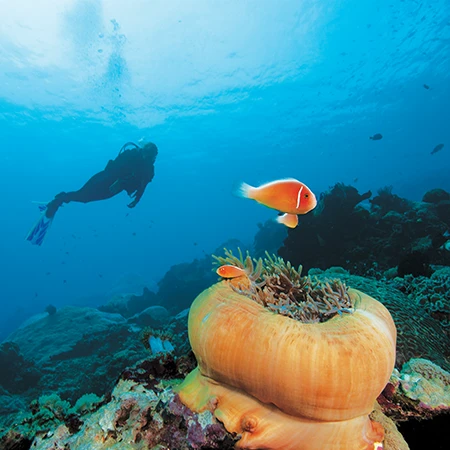
The dive lasted about 45 minutes, and we went down to roughly 41 feet (12.5 meters). We saw beautiful marine life. I watched clownfish moving among corals and spotted dwarf crayfish tucked into crevices. It felt like a dream come true to see these creatures in their natural habitat. The whole experience was relaxing and almost meditative.
Because we were doing the basic open-water course, we also had to practice certain skills. We made a three-minute safety stop at 16 feet (5 m) and then practiced a controlled emergency ascent under supervision. Being cautious newbies, we carefully followed our training.
I surfaced and climbed onto the boat, expecting to feel proud and happy. Instead, within a minute I felt lightheaded. Sitting down did not help. Then I felt tightness in my chest and had difficulty breathing. The right side of my body began cramping so severely that my right hand clenched and crushed a full plastic water bottle. I knew something was seriously wrong. The symptoms matched decompression illness (DCI).
I stripped off the top half of my wetsuit, lay down, and asked for oxygen. The staff reacted immediately, administered oxygen, and got us back to shore. I had to be carried off the boat and was whisked away in a bus to Kasih Ibu Hospital. My wife ended the dive to stay with me and handle administrative matters.
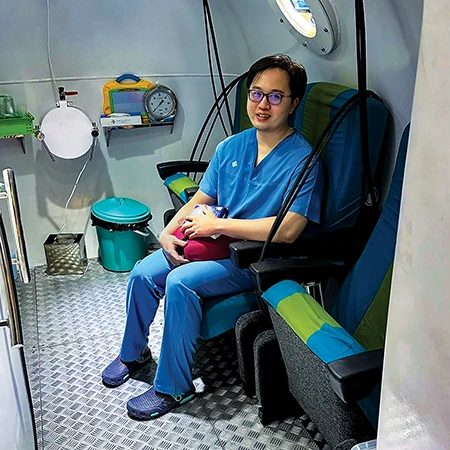
At the hospital I was given oxygen while I rested. I could not immediately enter the hyperbaric chamber because another group of patients was already inside. My chamber session started around 8 p.m. and lasted five hours. It was quite taxing for me because breathing pure oxygen in a pressurized environment was exhausting. My lungs felt tired by the time I came out.
The treatment worked, and after one session and medication from the hyperbaric doctor, I felt much better. I was cleared to fly home four days later.
Throughout the process, the dive school staff was extremely helpful. They visited me in the hospital, assisted with forms, and worked with DAN to activate my insurance. That support especially mattered when my wife and I were stressed, tired, and having a hard time thinking clearly in an emergency.
Only later did the financial reality sink in. The hyperbaric treatment was expensive. If I had needed to pay out of pocket, it would have been a major burden on top of the medical scare. Because I had DAN insurance, my entire hospital treatment was covered, and the experience was seamless.
Reflecting back, my wife and I were surprised that I got DCI. Although the dive was not deep or long, the training required us, as new divers, to simulate emergency ascents at the end of the dive. That additional step could have resulted in pulmonary barotrauma, which can manifest abruptly at the end of a dive and is consistent with my chest pain and the dramatic, one-sided neurologic manifestations I experienced.
We had done everything by the book — stayed hydrated, avoided alcohol, did not dive with a cold or flu, and were reasonably physically fit for our age — yet it still happened. The lesson I took away is simple: Diving is beautiful and calming, but it carries real risks, even on a dive that looks easy.
Insurance is not something to take for granted. DAN was there for me when I needed it most, and I would not dare to dive without it.
© Alert Diver – Q2 2026