Don’t Dive Without It
I’ve read about carbon monoxide (CO) in scuba breathing gas but wonder if people truly appreciate the real implications of diving with a CO-contaminated scuba tank. It is not only unpleasant but also can have profound health and safety implications. CO is colorless, odorless, tasteless, and incapable of sustaining life. It’s not a gas you want in your dive cylinder.
I have experienced CO contamination twice. The first time was in the Red Sea while diving Daedalus Reef. So many liveaboards were there that they tied up to one another, leaving a string of boats broadside to the brisk prevailing wind rather than trailing off bow into the wind as they might do on a traditional mooring. The exhaust from the generator did not blow safely astern but rather was swept into the compressor’s air intake and thereby into our tanks’ breathing gas.
On the next dive I knew it right away from the oily taste of the air and got out of the water early, escaping with only a splitting headache and a missed afternoon of diving. In retrospect, however, having strongly suspected that I had inhaled contaminated gas and was symptomatic, I should have sought immediate medical attention. The dive operator drained and refilled all the tanks, and we were fine the rest of the week.
It happened a few years later on another liveaboard, again due to a poorly placed air intake and prevailing winds flowing the engine and generator exhaust into the compressors. Carbon monoxide is 250 times more efficient than oxygen in terms of binding with hemoglobin. So even while diving enhances your blood oxygen levels, CO still overwhelms oxygen at a molecular level.
I did three very conservative dives on the first day but felt like I was bent that evening. My profiles were unprovocative for decompression sickness (DCS), so I was treated on board with IV fluid for dehydration and surface oxygen. I had flown straight from Florida to Asia, so dehydration seemed a reasonable hypothesis.
The next day I dived even more conservatively, with a maximum depth of 45 feet (13.7 meters) for 60 minutes, but felt worse by the evening. I didn’t dive for the next two days but then did one dive to 21 feet (6.4 m). After 10 minutes I deduced I might be breathing contaminated gas because it was irritating the roof of my mouth, and I flashed back to that day in the Red Sea.
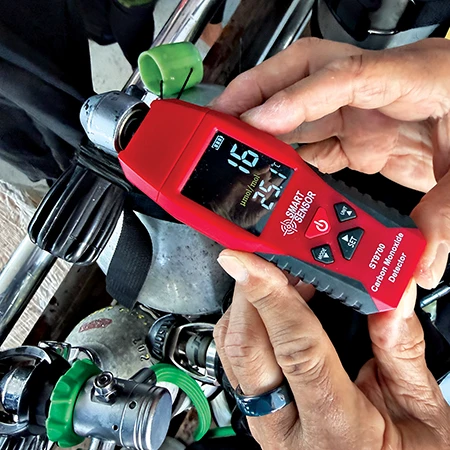
When back on the boat, I tested the breathing gas with my buddy’s CO analyzer and found all the cylinders had CO levels of 14 to 16 parts per million (ppm). I felt too bad to dive any more that week, but the next week of our holiday was at a land-based dive resort, so I was hoping to press on.
A DAN dive medicine physician considered my multiday dive exposures and CO contamination, assessed my mental and physical state, and convinced me to seek medical attention as soon as possible. DAN quickly located a hyperbaric facility near the dive resort and assisted me through the entire process. Over the next four days I had U.S. Navy Table 6 and Table 9 treatments to resolve neurological issues related to my dives and the CO exposure.
My symptoms eventually lessened, but the injury seemed more resistant to treatment than a traditional DCS incident. My nearly weeklong delay in treatment while on a remote liveaboard may have played a large part in the slow response and recovery.
DAN and my hyperbaric medical team reinforced the following information:
- Do not dive if unwell. Promptly notify your dive team in case others are similarly affected.
- CO poisoning can exhibit symptoms similar to DCS, but the first aid is the same: surface oxygen on location and hyperbaric treatments if needed.
- Depth compounds the hazard. My 16 ppm at the surface was more like 50 ppm at the depths we were initially diving.
- The risk of CO intoxication increases with time and depth, and it can be fatal.
Others on the liveaboard were also affected. Several vomited, and one was treated with surface oxygen. Another diver who went to 102 feet (31 m) came up with a splitting headache and retired to his cabin for the rest of the day. Everyone reported nonspecific fatigue. DAN notes that an unwell diver should not be left unattended and without a working diagnosis. Frequent vital sign and neurological checks are recommended.
My physician said I was the first CO poisoning case he had treated in his 40 years running the chamber. Or was I the first who had a CO analyzer to test the gas and report the issue? Fortunately, CO contamination is relatively uncommon. Dive operators usually monitor their breathing gases regularly and are alert to compressor operations, complaints of breathing gas taste or smell, and symptoms affecting previously well divers.
Yet, the risk is real, but prevention is achievable. Divers should travel with their own CO analyzer and evaluate their own gas. The device can also monitor the CO levels in your liveaboard cabin, camper, hotel room, etc. I should’ve bought one after that Red Sea experience, but I have one now — and will never again travel without one.

© Alert Diver – Q3 2026