The Silent Killer
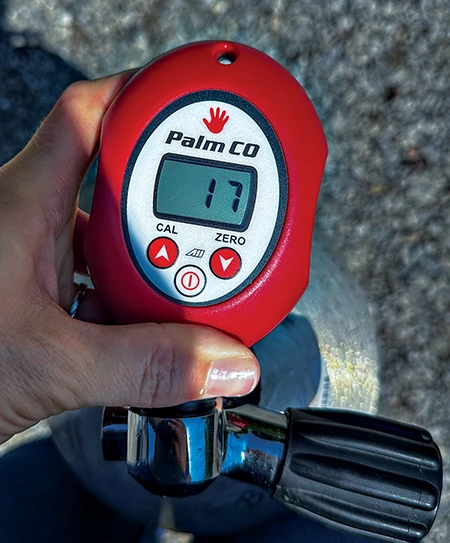
A diver reported feeling unwell after a series of dives and described an uncomfortable irritation on the roof of his mouth, which raised a question about the quality of the breathing gas. A safety‑conscious diver used a portable carbon monoxide (CO) analyzer to test a random cylinder filled from the same compressor.
The reading indicated a level of 16 parts per million (ppm), which is above the U.S. allowed limit. While the diver’s symptoms were possibly consistent with CO poisoning, that level should not have caused harm, even when factoring in the modest dive depth. This assumption, however, raises important questions about safe limits of theoretical versus real‑world conditions.
In a previous article on limits to avoid CO toxicity, we noted that the 10 ppm limit set by the Compressed Gas Association (CGA) Grade E specification is considered safe for breathing air at normal dive depths. Other international standards are lower, typically no more than 5 ppm.
Occupational health and safety standards require CO levels in a working environment to average no more than 35 ppm over an eight‑hour period and to never exceed 200 ppm for more than 15 minutes. Even accounting for higher partial pressures of CO at depth, divers rarely breathe compressed air continuously for eight hours. Compliance with the CGA Grade E limit at 165 feet (50 meters) — the no‑decompression depth accepted by some agencies and based on a safe oxygen partial‑pressure limit of 1.26 atmospheres absolute (ATA) — implies that a diver is breathing a surface equivalent of 60 ppm.
In a dive setting, however, CO readings should ideally be zero. Levels above 5, 10, or even 20 ppm at the surface are not necessarily dangerous by themselves, but any detectable CO in a scuba tank from an appropriately installed and maintained compressor indicates contamination by combustion gases or other sources, such as paint, cleaning fluids, cooking exhaust, or rotting organic matter.
Breathing contaminated gas at depth amplifies the effective exposure. A surface reading of 16 ppm during a 60‑foot (18-m) dive (about 2.8 ATA) corresponds to an effective exposure of just under 50 ppm for the duration of the dive. While this is concerning, it is below clinically significant toxic levels. The threshold for symptomatic CO toxicity is substantially higher than the level to which this diver was likely exposed, but tolerance to CO toxicity can vary from diver to diver.
Why are we concerned about elevated CO levels? Hemoglobin inside red blood cells carries almost all the oxygen in our system. When CO is introduced, it binds to hemoglobin and displaces oxygen, forming carboxyhemoglobin (COHb), one of the indicators of CO toxicity. The greater the CO, the more toxic the effect and the more rapidly we become hypoxic.
As we dive deeper, oxygen in the breathing gas dissolves directly into plasma, the liquid component of blood. This dissolved oxygen partially offsets the reduced oxygen‑carrying capacity caused by COHb, but as we ascend, COHb levels remain high for several hours while dissolved oxygen rapidly decreases. A diver becomes more hypoxic, not less, during ascent and after the dive.
The expected limit for CO in the environment is zero. If levels are above this, as 16 ppm in our example implies, there is a source somewhere. We need to know what it is, where it is, and whether it can suddenly introduce a large amount of CO near the compressor intake. A gasoline engine or generator powers the compressor on a boat, so we have a ready source of CO, even when the boat engines are not running.
A sample is not the same as continuous monitoring. While one batch of cylinders may read 16 ppm, another could be much higher. Without additional sampling, we can’t know unless we observe a diver feeling unwell or worse.
Breathing‑air compressors — especially those located in environments where CO may be present, such as on a boat — should always have filters with a CO catalytic converter. The catalyst continuously converts CO to carbon dioxide, yielding an expected result of 0 ppm.
There are limits, however. When CO entering the compressor exceeds the filter’s overload limits — usually 50 to 100 ppm for a properly sized filter — some CO will pass through. The filter’s ability to convert CO further decreases in humid environments. The CO‑removal process generates heat, related to the amount of CO. Excessive heat degrades the catalyst, further reducing its effectiveness.
A reading of 16 ppm in a cylinder likely indicates the catalytic converter is being overloaded due to a significant amount of CO in the air near the compressor intake. If levels rise further, the filter’s effectiveness drops even more. When breathing gas contains any amount of CO, either the filter does not contain a catalytic converter or it is overextended by moisture, heat, oil, or volatile compounds. There must also be a significant CO source nearby.
This recent event is a serious reminder of the toxic killer: the tasteless, colorless, and invisible contaminant that we strive to eliminate completely. Toxicity from breathing gases remains an essential component of the differential diagnosis and is particularly relevant to dive medicine physicians assessing potential dive injuries.
The following are some useful safety considerations for all filling‑station operators working in environments where elevated CO levels may exist, such as near a gas‑powered engine or generator on a boat.
- Install a continuous CO monitor, preferably one with data‑logging capability. The device tracks the CO level in each cylinder based on when it was filled.
- If a monitor is impractical, test one cylinder from each batch for CO before releasing the cylinders for dive operations. Record and maintain all your results.
Divers have the right to expect that the operator has things under control, especially where CO may be present. If you are unsure or want to take added precautions, you can test a cylinder’s purity in less than a minute with a small, handheld analyzer.
One added benefit of a portable CO analyzer in your dive kit is that it’s useful in a liveaboard’s sleeping quarters for alerting occupants to even small CO levels. A suitable, inexpensive analyzer with a range of 0 to 100 ppm should provide early warning of trouble on board.
© Alert Diver – Q3 2026