Humming with History
The sea has a way of calling. It comes quietly at first with a pull in the chest and a whisper in the tide. After nearly 40 years on the island of Maui in the Hawaiian archipelago, I listened to that voice again and moved west to Guam in 2023.
When people heard the news, their questions arrived quickly: Where is Guam? Why would you do that?
There is no single answer to the last question. It is the sum of small choices, a life shaped by islands and salt water, and a need to see the familiar from a new horizon. Since arriving on this small, emerald speck in the Pacific three years ago, I have not looked back. The days roll by, warm and blue, and there is always more to discover above and below the surface.
An Overlooked Island
Guam is a hub for Micronesia, a stepping stone between continents, and a place travelers pass through on their way to Palau, Chuuk, or Yap. It’s the kind of island most divers have heard of but seldom linger on — a layover rather than a destination.
Palau, Chuuk Lagoon, and Yap boast grander reefs and richer biodiversity along with a promise of manta rays, ghost fleets, and perfect visibility. Guam’s beauty, by contrast, is quieter. It is subtle and resilient, shaped by history and held steady by those who call it home.
Guam, an unincorporated U.S. territory, is a 212-square-mile (549-square-kilometer) lush tropical island that sits alone in the western Pacific and is the largest and southernmost of the Mariana Islands. The terrain feels like two distinct halves. To the north, the land rises gently, with limestone plateaus and rolling hills covered in tangles of ironwood and coconut palm. To the south it turns volcanic, with dark ridges, red earth, and deep river valleys cutting their own paths through the stone. Coral reefs ring the island like a necklace.
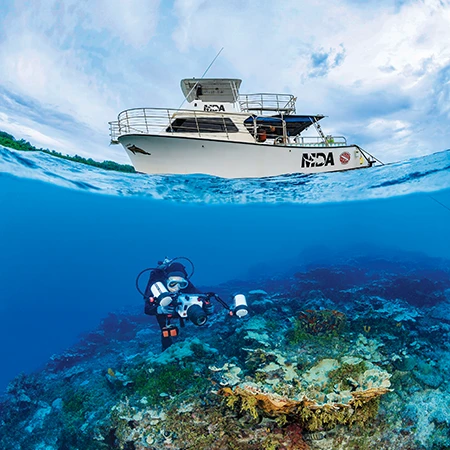
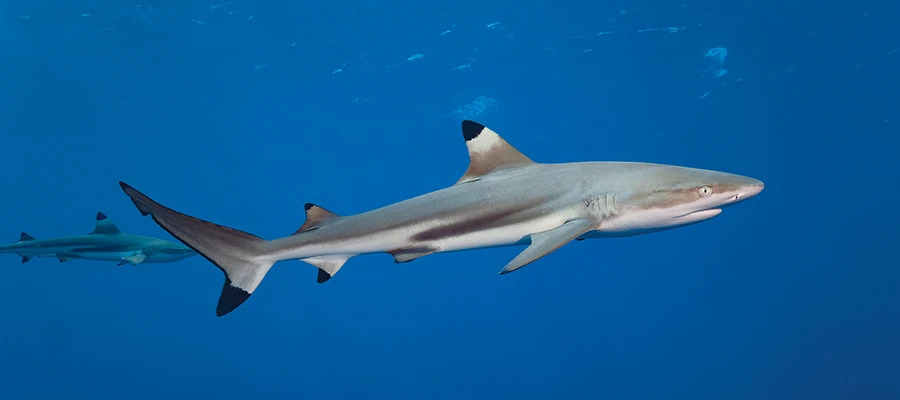
The water is why people come and many stay. The sea around Guam is warm year-round and clear enough to see your shadow on the sand 100 feet (30 meters) below. The reef fish are bright, and the coral is abundant. Manta rays glide like silk. Reef sharks cut through the blue with the steady rhythm of the tide.
Life on the Island
Guam’s capital, Hagåtña, lies near the middle of the west coast. The village of Dededo, where I live, is farther north and holds most of the island’s people. Beyond that, the roads narrow and the air smells of sea spray and breadfruit.
The island’s geography makes it strategic, and the U.S. military has bases here for the Navy, Air Force, and Marines. The economy leans on three steady legs: tourism, the military, and government work.
Guam is a tapestry of Chamorro, Spanish, American, and Asian cultures. Everywhere you go you hear the greeting “Håfa adai.” It means “hello,” but it conveys warmth, welcome, and a sense of belonging. It’s the kind of phrase that stays with you, like the smell of salt after a dive.
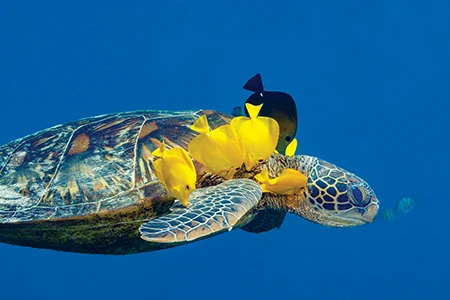
dead skin from a green sea turtle.
The Light and Water of Guam
The air is thick with humidity and life. The average temperature hovers around 82°F (28°C). There is no true winter, only the change of light between the dry season and the wet. The sky stays bright and dry from December to June; from July to November, the rain returns, feeding the jungles and washing into the sea.
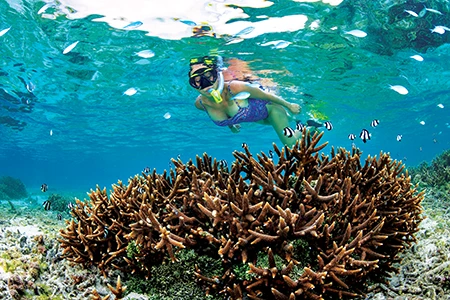
Tumon Bay, on the island’s western shore, is Guam’s answer to Waikiki — a crescent of hotels and beaches, glassy water, and white sand. The coral inside the reef is accessible when the tide is in. Some areas are unreachable at low tide, but you can stand waist-deep with your mask in the water and watch parrotfish graze the coral heads. At high tide, the bay becomes a shallow aquarium as butterflyfish, wrasses, and damselfish drift like confetti over the reef.
At the southern end of Tumon Bay, Ypao Beach holds the best coral. The growth there is healthy, dense, and colorful, with gold-tipped branching corals and tangs flashing through the light. The fish are used to people: They pose, circle you, and stay. It’s the perfect place to test a camera housing or get lost in small details.
Where History Meets the Sea
Farther north lies Gun Beach, which got its name from the relic that still rests near the cliff: a rusted World War II-era coastal gun left by the Japanese during their occupation. It is a reminder that even paradise bears scars.
A parking lot leads to a short walk to the shore. From there, a cut channel in the limestone floor guides you toward the outer reef. The trench was carved decades ago for oceanic cables that run beneath the sand to the open sea. It is a perfect runway, leading divers to greater depths.
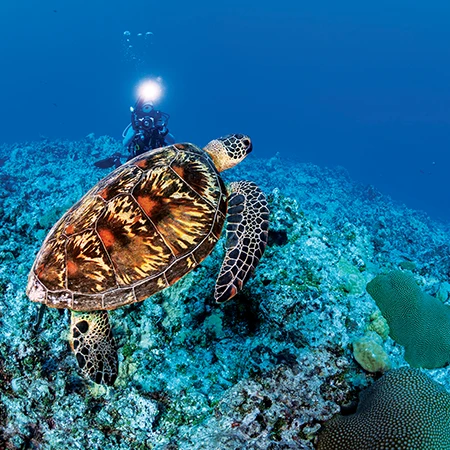
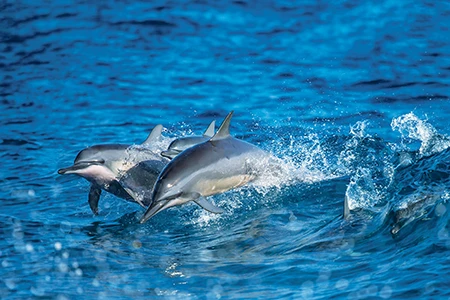
I have seen more green sea turtles at Gun Beach than anywhere else on Guam. They rest on the coral, indifferent to divers who drift close. Eagle rays glide past the drop-off on clear mornings, and sometimes a manta sweeps in from the blue. I once saw spinner dolphins at the edge of visibility; their silver shapes flickered like ghosts and then were gone.
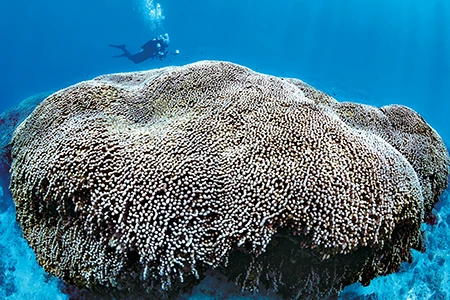
A long swim northward reveals a massive coral formation the size of a small cottage, often with turtles ringing it. The coral is old and layered with years of growth, and its shape indicates the reef’s resilience. The currents can shift here, but the water is clean and full of life.
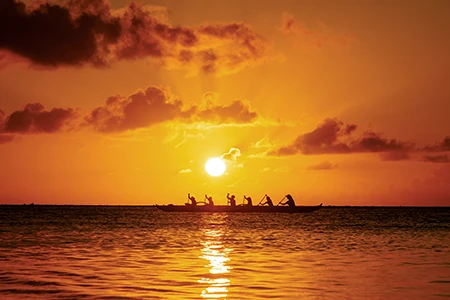
the horizon, paddlers drive a traditional outrigger canoe across the calm waters of Tumon Bay.
The Piti Bomb Holes
South of Tumon, in the village of Piti, lies one of Guam’s most famous sites: the Piti Bomb Holes Marine Preserve. The name comes from the large, circular sinkholes that pockmark the reef flat. Early visitors mistook these natural formations for bomb craters. The holes are filled with corals and fish, each one a miniature world of color and motion.
In 1996 a commercial underwater observatory called Fish Eye was built here. A steel and wooden boardwalk stretches nearly 300 feet (91 m) from shore to the observatory dome, where visitors can descend to large viewing windows about 30 feet (9 m) below the surface. For divers and snorkelers, the structure offers an easy path to the first hole.
Sergeant majors, moorish idols, damselfish, and butterflyfish are accustomed to the click of cameras and the curious eyes peering from behind masks. Photographers love this site for its accessibility and color. If you’re lucky, blacktip reef sharks might pass by on the edge of visibility, moving like silent shadows.
The reef glows brightest in the morning, when sunlight slants through the water, lighting up the coral gardens. It’s an easy dive, but one that rewards patience and a slow pace.
The Tunnels of Piti Channel
Piti Channel lies not far south, beginning under the Cabras Highway and stretching toward the open ocean. Four concrete tunnels run beneath the road, built to circulate seawater for the power plant’s cooling system. Over time these tunnels transformed into a living reef and a sanctuary for small life.
This dive is a lesson in timing. When the surf breaks heavily over the outer reef, the tunnels churn like a washing machine. On calm days, they are still and bright, and the concrete walls are alive with sponges, cowries, and corals.
Octopuses tuck themselves into crevices, and squids hover near the openings, changing color as they drift. For photographers, it’s a macro paradise. For divers, it’s an odd experience — human-made but reclaimed by nature.
The Signature Dive
Every island has its showpiece. On Guam, that’s Blue Hole. This vertical shaft, cut deep into the limestone plateau, lies offshore on the western side. The entry begins at 60 feet (18 m) and drops past 300 feet (91 m). A window opens onto the wall at 130 feet (40 m), a framed view of open water that looks like a cathedral door.
You pass through that arch, and the world opens wide, endless, and cobalt blue. Schools of jacks swirl in the distance, their scales flashing silver. Barracudas hover motionless in the current, and reef sharks patrol below. The visibility can reach 100 feet (30 m) or more. On most days you can see the shadow of your boat from the bottom.
Blue Hole is a dive that reminds you of scale: how small a human is in the open sea, and how vast the Pacific really is.
The Wrecks of Apra Harbor
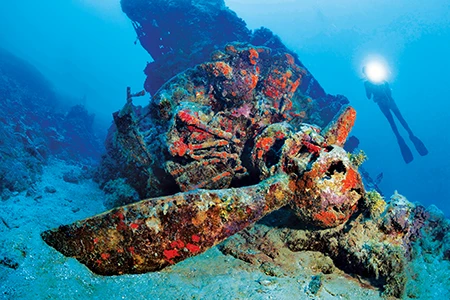
Guam’s waters hold more than coral. They hold history. In Apra Harbor two shipwrecks rest side by side, one from each world war. The SMS Cormoran, a German transport ship, was scuttled in 1917. The Tokai Maru, a Japanese freighter, was sunk by a U.S. submarine in 1943. Now they lie together, the only known site in the world where wrecks from both world wars touch.
The two ships rest between about 40 and 130 feet (12 to 40 m), their hulls leaning toward one another in the dim light. Coral growth is scattered over the decks, and fish weave between the twisted steel. It’s quiet down there — the kind of quiet that feels sacred.
Inside Apra Harbor, life flourishes. The reefs are healthy despite the nearby container ships and naval vessels. The coral drops in terraces, and elephant ear sponges grow unexpectedly wide. Green and hawksbill turtles drift lazily near the coral heads, followed by surgeonfish looking to nibble algae off their shells. Among the debris of history, life goes on.
When the Sun Goes Down
Guam’s reefs transform at night. Octopuses emerge from their holes, changing color with each breath. Slipper lobsters scuttle along the sand, and parrotfish sleep inside translucent cocoons of mucus that shimmer under the dive light. The sea at night feels alive in a different way — quieter, yet more electric.
Many divers prefer the daylight, but night diving here teaches patience and awe. The same reef that seems familiar at noon becomes alien and mysterious after sunset.
The Blackwater Beyond
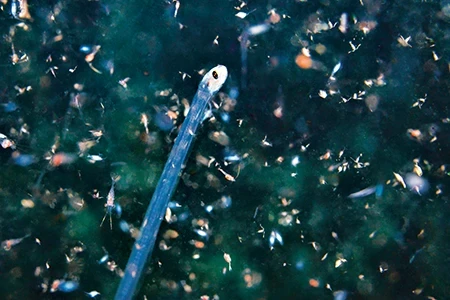
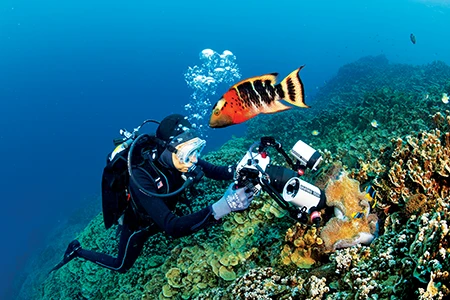
A group of local underwater photographers formed the Guam Underwater Photographers Society. We share images, techniques, and laughter over postdive get-togethers. Occasionally, we charter a boat and head offshore for a blackwater dive, descending into open ocean at night, cameras ready, and lights suspended in the dark to attract drifting life.
It’s always a gamble. Some nights nothing appears but the faint dust of plankton. Other nights the sea delivers magic: larval fish, racing squid darting by, jellyfish like glass ornaments, and other creatures that rise from the deep only when the sun is gone.
Floating in that infinite blackness, you feel what Wendell Berry might have called the “peace of wild things.” You are small, weightless, and part of something vast.
The Island and the Sea
Guam is not the kind of place that reveals itself all at once. Its beauty comes in layers: limestone and lava, jungle and reef, day and night. It is both wild and tame, American and foreign.
The sea shapes everything here. It defines the light, the rhythm of the day, and the patience of those who live close to it. Divers come for the coral, the marine life, and the wrecks, but they stay for something harder to name: a kind of quiet that sinks into you after enough time underwater.
For me, Guam is both a beginning and a return, a place that feels new and familiar all at once. The island hums with history. The reefs still breathe. And every dive, every slow descent into blue, reminds me why I came.
Some places don’t need to compete with the famous ones. They just need to be known by those who are meant to find them. And Guam, for all its overlooked corners and hidden depths, is one of those places.
Explore More
See more of the Guam in a video below.
© Alert Diver – Q2 2026