I have been diving rebreathers recreationally since the mid-1990s and have been a rebreather instructor for just as long. When I started wearing a mouthpiece retaining strap (MRS), sometimes called a gag strap, other rebreather divers bemoaned my decision. “Are you crazy? You don’t need that,” they said. “It’s not comfortable. It’s annoying!” I did not think they were wrong.
I continued to wear it, however, because it came standard with one of the devices I had bought and on which I was teaching. The unit’s designer had told me the MRS was mandatory and not to remove it from the loop. As a longtime practicing lawyer specializing in liability, I did not want to risk being liable for any problems or void the warranty to my unit.
My motivation for using the MRS changed, however, after an incident several years ago, and I have worn one on every dive ever since.
That day is still very clear to me. I was experiencing some personal health and family issues at the time and was overworked and overtired. I probably should have rested at home, but diving was an escape from my troubles. I was excited to forget about it all and enjoy some underwater time.
I had training dives with two of my rebreather students. We had no issues and surfaced that sunny afternoon after successfully completing our second set of planned dives.
My usual procedure is to stay in the water to ensure my students safely get into the boat before I board. I remember floating at the surface next to the boat, watching my students climb in, and then nothing more.
I heard a faint beeping, like a faraway alarm clock trying to wake me up. I was exhausted and thought I was dreaming. I felt very cold and did not want to get out of bed. With my eyes still closed, I reached down to pull up the blanket but grabbed my drysuit instead. I was not in bed — I was lying alone underwater on the bottom.
There was no sudden rush of realization; I did not immediately understand what was happening. Am I now dreaming that I am diving? Am I dead, and this is some kind of divers’ paradise?
I looked at my computer, which showed that I was on a third, unplanned dive and facing 85 minutes of decompression. I still did not comprehend what was going on and was not fully convinced that this was real. The cold water and the loop rigidly affixed to my mouth via the MRS gradually made me realize that yes, this is actually happening. I eventually realized that I had been unconscious for about 60 minutes and was alone at 148 feet (45 meters) at the bottom of the ocean.
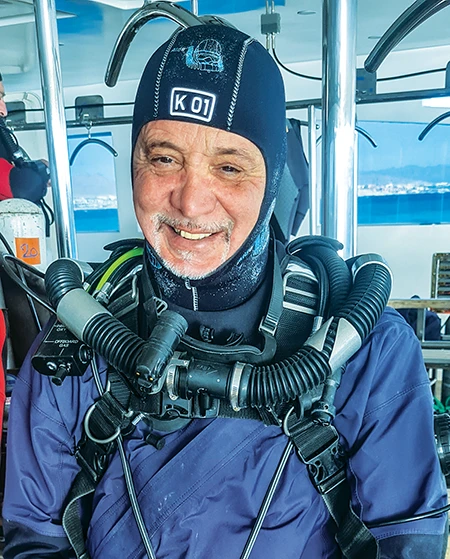
Amazed at my predicament, I quickly took stock of the situation. I felt very cold but was wearing a drysuit, so I knew I’d be fine in regard to exposure. There was no water in the rebreather loop, despite me being slack-jawed and unconscious for an hour. The MRS had kept the mouthpiece secured to my lips, so I had been safely breathing from the closed circuit instead of aspirating water.
My rebreather’s continuous mass flow (CMF) orifice and oxygen solenoid worked together to maintain a stable partial pressure of oxygen (PO2), adding the correct amount of oxygen to the loop while I was out. I had enough gas and scrubber time left to safely manage my unplanned decompression obligation, so I knew that if I remained calm and used my time wisely, there was no reason I wouldn’t be able to make it back to the surface.
I remembered where I was last geographically, but I didn’t know where I was now or how far I might have drifted. I knew what general direction the mainland of Italy was, so I set an azimuth with my compass and started heading toward what I knew would at least be shallower water and not further out to sea.
As the bottom contour started rising, I was elated and grateful that I had remained in relatively the same area and had not drifted to deeper water. I knew the wall of rocks in front of me underwater was a cliff face off one of the smaller islands near Italy’s coast, though I wasn’t sure which harbor was nearby.
After finishing my decompression, I surfaced in the pitch black of night. The rocky cliff face was unclimbable, so all I could do was wedge or beach myself into the boulders at the water’s edge and hold on the best I could in the swells.
I was exhausted, and it was nighttime, so I figured I would be sleeping on the rocks until morning. I lay there for a few hours, half asleep and shivering but in fairly high spirits — after all, I was still alive. Nothing could damper that level of mood elevation.
Later I saw a fishing boat and started flashing an SOS signal using a little green light that I keep with me for cave diving. The boat came toward me but then turned away, likely thinking I was fishing illegally, and they didn’t want to involve themselves in my trouble.
When I signaled another boat that passed by, they stopped to see what was going on. They had heard on the nightly news about a missing diver who was presumed dead and realized that was me. They came to my rescue and took me back to the port from which I had departed the previous day.
At the hospital I was tearfully reunited with my fellow divers, who had thought I was dead. When they could not locate me, they called the coast guard and searched for me underwater until dark. For the hour that I was unconscious and on the bottom, boats and helicopters with spotlights were flying all over, looking for me on the surface with no success.
After numerous tests at the hospital, medical personnel concluded that I had lost consciousness on the surface due to overexhaustion and health issues I was experiencing at the time. My rebreather unit functioned flawlessly, independent of any operator control for one hour, providing the correct amount of oxygen needed to maintain a stable PO₂ at my depth.
The saving grace was wearing my MRS, which kept my mouth on the loop and safely breathing gas. If I had not been wearing the MRS, the loop would have fallen from my lips, and I would have drowned before my lifeless body hit the ocean floor.
I am living proof that proper use of the MRS while rebreather diving can save a diver’s life.
© Alert Diver – Q2 2026