With our finite time and limited light underwater, every image-capture quest is like a treasure hunt. We all have different ideas of what is treasure: It may be marine mammals, shipwrecks, reef corals, or icebergs. I like to go beyond a single underwater subject and look for something more abstract. Pattern, form, and color rule my world.
I process the world visually, so searching for subjects with a special combination of dynamic elements is my favorite type of treasure hunt. I have a visceral reaction to color and light, but color alone is rarely enough to make an exciting photograph. Patterns draw the eye, evoke moods, and provide design structure for compositions. These considerations are fundamental in fine arts and photography.
Creating a unique image using these elements takes practice to determine your preferences for how to combine them. Challenging myself to develop my shooting style while witnessing the wonders of the reef that transcend simple identification has kept me diving with a camera for more than three decades. It has been crucial for me to slow down and get familiar with dive locations so I can begin to notice when a unique vision presents itself.
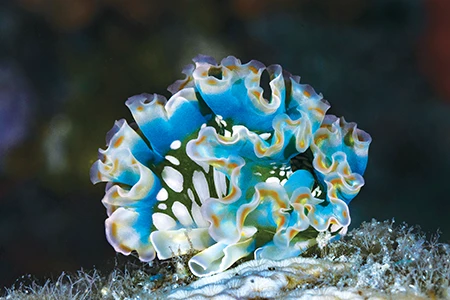
This nudibranch I found in Dominica was a spectacular specimen of Elysia crispata, commonly called a lettuce sea slug. The coloration was more extraordinary than any I have seen in the species and reminded me of a blown-glass sculpture. I photographed it to highlight the undulating color folds and the abstract nature of its flamboyant, otherworldly patterns. I showcased its wild colors with simple front lighting and dark negative space behind the nudibranch.
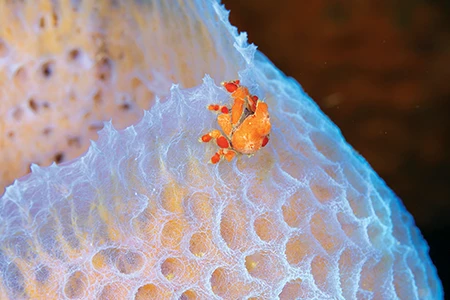
Small but mighty subjects abound. A uniquely Caribbean color palette in this scene of reef life is a good example of revealing small but bold details. This bright red crab crawling along a luminous azure vase sponge packs a punch of color and an arresting depth-of-field effect. It is easier to
find some of these scenes on a night dive, where you can focus on what is lit and right in front of you. When you find small organisms with intriguing colors or behaviors, you can compose a strategic arrangement.
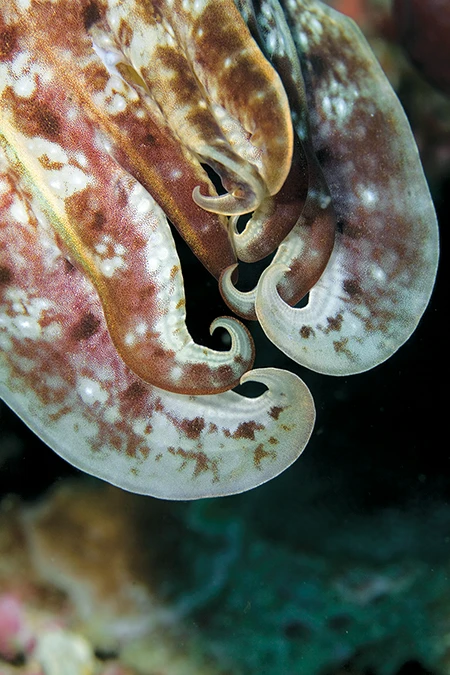
The curves and definitions of this cuttlefish’s tentacles were an irresistible abstraction. The sculptural curls were more interesting to me than the animal as a whole. Vignetting in photography is a dramatic alteration away from the center or subject in composition or brightness. You can create this naturally with selective lighting or in postproduction. Capturing brief moments like this can transcend a portrait of a cephalopod into a work of creative expression. Artistic elements and abstract details are everywhere underwater if you really look.
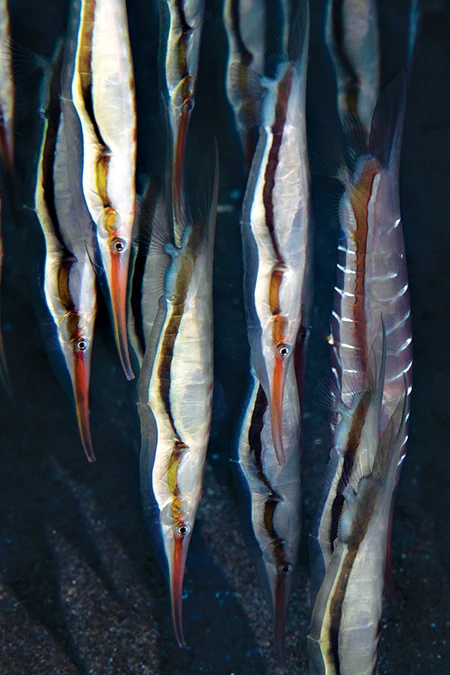
A momentary alignment of organisms in the water column, like these razorfish in a small vertical school, is a perfect challenge. With their scales reflecting light as they pulse in unison, a school can be more interesting than a lone fish. Flowing forms with color variations that repeat let you play with symmetry and asymmetry.
Once you have cultivated a practice of looking slowly to notice the extraordinary, where do you start when trying to develop your personal interpretation of those vignettes you remember long after a dive? Defining the terms that explain the vital elements of my compositions is helpful in understanding my process.
Color is the visual perception of light waves reflected or emitted by objects and interpreted by our brains as hues like red, blue, or green. It’s not an inherent property of objects but a result of how they interact with light. In physics, color is associated specifically with electromagnetic radiation of a range of wavelengths visible to the human eye. Every human eye sees color a little differently.
A pattern is a predictable, repeating arrangement or design, such as the passing of seasons or the repetition of phrases in music. A consistent order of colors, shapes, lines, and textures can create patterns. A pattern that repeats, mirrors, or connects similar forms grabs my attention. Colors are also a factor in seeing a pattern, whether the pattern is monochromatic or multicolored.
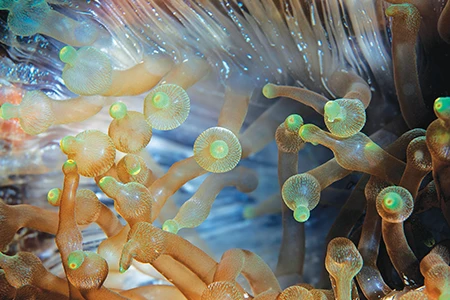
The organic feel of bokeh, or out-of-focus areas, has various interpretations. The glowing green tentacle details of this anemone created the feeling of peering into a tiny universe. The color palette could be a nebula or a microscopic cell detail. Using variable depth of field and shifting brightness to keep the eye moving gives the image energy.
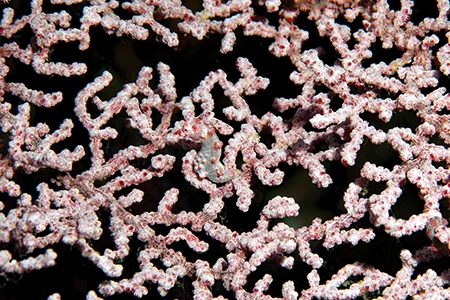
The pink sea fans that house these pygmy seahorses are a labyrinth. The beauty of the mazelike forms lies in the terrific pattern, made even more interesting by the perfectly camouflaged residents. The trick with these tiny fish is creating an image that goes beyond documentary. The angle of the fish’s face is important, but placement in the frame is essential for composition. The rule of thirds is necessary for a shot like this. Crafting a visually pleasing arrangement of a creature and its host, with contrast and color, requires graphic balance.
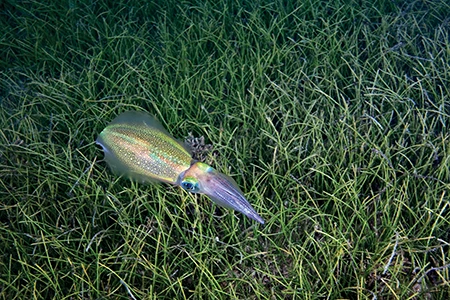
Squid Above Seagrass
Squids are fascinating, with their chromatophores (pigment organs) that let them instantly change their skin color. This squid in the shallow seagrass in Tonga was of particular interest due to the palette of greens. The color and unusual textures in the seagrass as the squid tried to swim while remaining hidden piqued my interest.
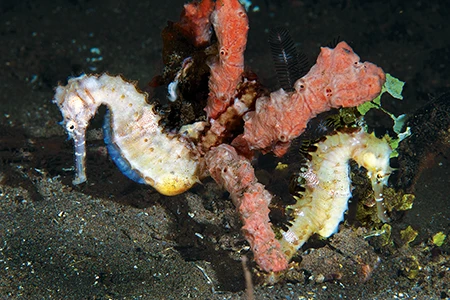
Seahorses are always fun to find; the twitch of an eye can give away their hidden forms. They are masters of camouflage, matching their color and texture to their preferred home, whether it is seagrass, sponges, or other reef structures. Creating balance and focal points in an image is not easy with delicate, moving subjects like these. The goal is to identify the scene and compose a story in a single frame. The curving forms in this image mirror one another, creating visual harmony.
Shape is the form, contour, or outline of an object. Its geometry is three-dimensional, but photography renders it in two dimensions. Interpreting how to adapt shapes to the medium in your compositions is a matter of creative preference.
You never know what you will see, but I always hope that nature and technology cooperate. I use a Canon EOS R5 Mark II camera in a Nauticam housing with Sea & Sea and Backscatter strobes. My favorite lenses are the Canon 15-35mm and 100mm macro.
Finding your favorite reliable gear and practicing with different elements in your photos can set you up for your ideal treasure hunt.
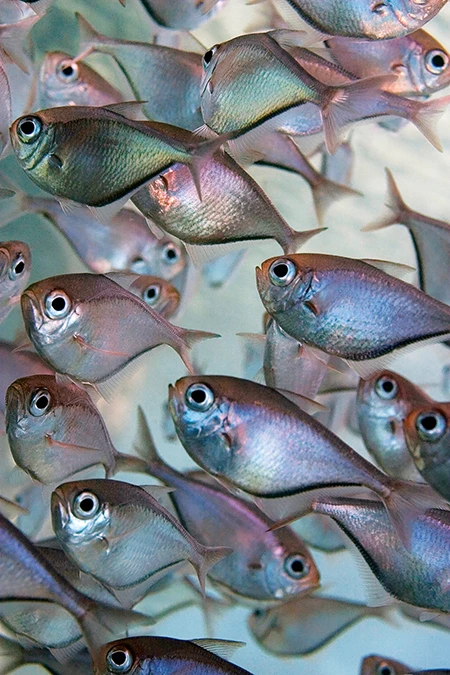
I found these glassy sweepers between pier pilings in Dominica. The subtle light under the pier created a muted tone. Their shimmery wiggles wove a little tapestry I have yet to see again. The black of the eyes punctuates the monochrome of their bodies, giving some contrast to the otherwise uniform color. Monochrome subjects require compositions that offer a place for the eye to connect and rest. One element that differs slightly can provide contrast or unexpected detail, making monochromatic scenes come alive.
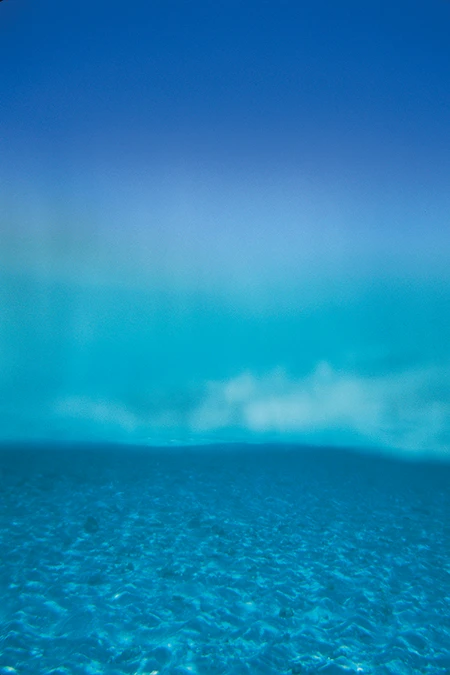
I shot this image in the Maldives on film to capture my favorite colors of blue. I love the challenge of communicating the energy between sky and sea. The color gradation can be smooth or sharp, but the transition signals change. I admit to more failures than successes in this area. Balancing color and focus is not easy. Practicing throughout the day is a good strategy to get used to reacting as the light changes.
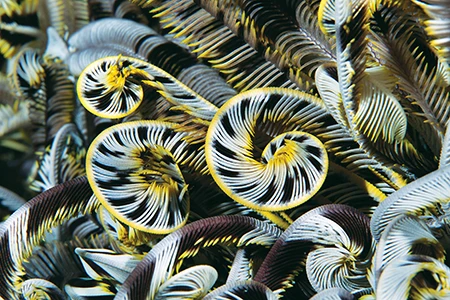
The crinoids in the Philippines are abundant, and with this concentration of life there are many variations in color and pattern. The perfect coils of tightly wrapped arms are exquisite, and waving, outstretched arms are mesmerizing. Creating an image of a crinoid that goes beyond simple pattern repetition requires careful composition, and negative space comes into play. Forms can be intricate or stark. Some have shrimp hiding in them, but it is mainly their feeding structures that I enjoy observing. It is like photographing a dance. Crinoid arms are an infinitely rich subject, and I recommend taking a closer look when you get a chance.
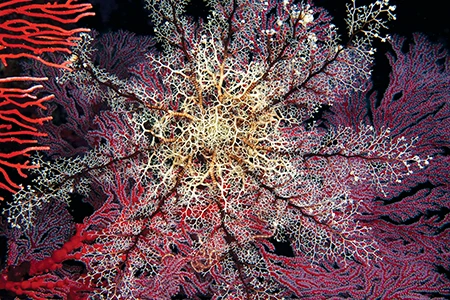
Basket stars unfurl their arms at night when they feed. They wrap up tightly into a ball during the day for protection and are not particularly thrilling when they appear as a closed fist of arms. As darkness falls, they extend their delicate arms, creating an elegant textile of form and function against a black curtain of night. Add some layers of color behind, and a true tapestry of color and pattern is revealed.
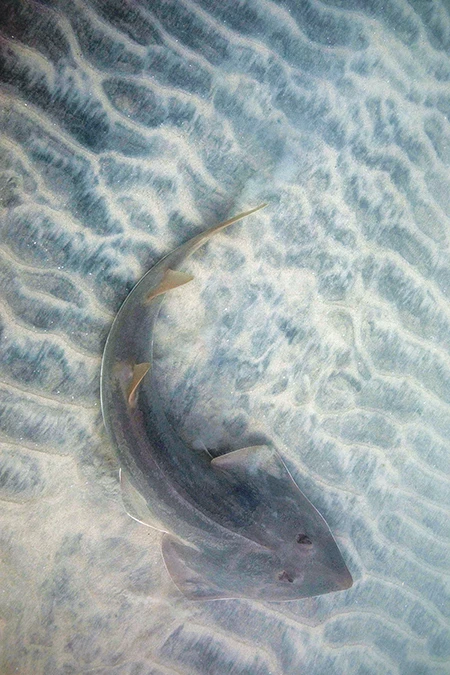
Patterns in sand and water are already beautiful, but they can be more exciting when you add an animal with adaptive behavior. This shovelnose ray in the shallows of La Jolla Shores off San Diego, California, is a perfect match for its environment. It was almost invisible to predators or prey when it disappeared into its home. Subtle tones and contrast give away its form when shooting from above. This image is also monochromatic but has graphic detail with lines and movement.
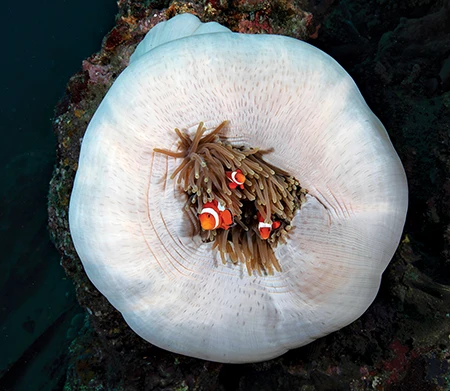
The dramatic geometry of a white circle against black was an exciting discovery. This large white anemone, closed for the night in the waters off Puerto Galera, Philippines, presented a unique perspective. Radial symmetry is common with anemones, but it is rare to find one closed in such a perfect circle. Its host anemonefish, tucked into the mouth for the evening, compressed the fish action into the center. The white shape against the dark evening waters created a stark contrast with the splash of subject color and personality at the center.
© Alert Diver – Q2 2026