On a typical morning at Picnic Cove in Laguna Beach, California, in 2023, Val Marino was prepping for what was meant to be a routine dive. She was excited to continue working on a dive site mapping project that was a part of her divemaster course, but instead she found herself navigating a real dive emergency.
Marino’s introduction to diving was a Discover Scuba course she took at age 12. She was immediately hooked on being underwater. She took her open water course at age 15 and continued progressing through her training. By 2023 she was a rescue diver actively pursuing her divemaster certification.
She originally became certified in first aid and CPR in 2013 while earning her teaching credential. She regularly refreshed her certifications to stay active and eventually took the DAN Diving First Aid (DFA) course alongside her Rescue Diver certification. The training was a key step in becoming a dive professional, and a year later she put those critical skills to use.
Marino and her dive buddy, Larry Berlin, were setting up their dive equipment on the beach and preparing to enter from the shore when they noticed another diver from their group signaling for help in the water. Berlin immediately entered the water to assess the situation, while Marino told a nearby parent of one of the divers to be ready to call 911 if the situation was serious.
Moments later, Berlin called for Marino, and she dropped her gear and rushed through the surf without hesitation. As she made her way through the waves to the injured diver, it was immediately clear this wasn’t a minor issue or a tired diver needing a tow to shore — this was a genuine emergency. The injured diver had yellow foam pouring from their nose and mouth, their eyes were unfocused, and they were completely unresponsive.
Berlin had already removed the diver’s equipment, so Marino made quick work of towing the diver to shore and dragging them onto the beach. This wasn’t an easy rescue: Marino is only 5 feet, 3 inches tall, and the injured diver was significantly larger, but she never hesitated.
Her adrenaline kicked in as she maneuvered the diver through the surf and onto the beach, where she shifted immediately from rescue to assessment mode. Despite the seriousness of the scene and her physical exhaustion, her training took over. Marino quickly assessed the diver’s responsiveness, breathing, and pulse before beginning CPR.
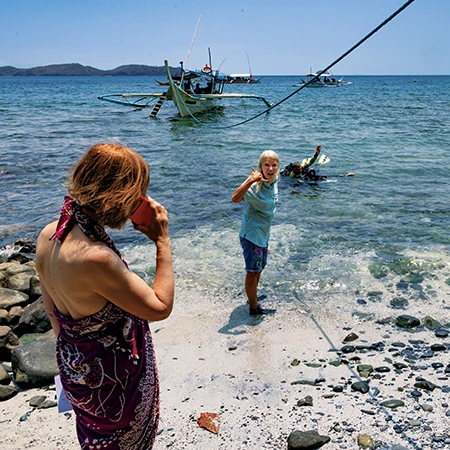
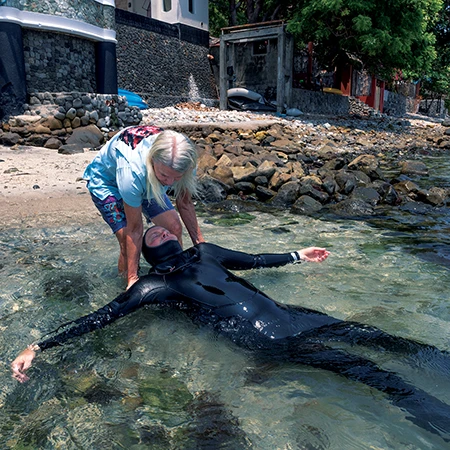
The emergency response became a coordinated effort as the situation progressed. The individual Marino had communicated with earlier contacted emergency medical services (EMS), while another bystander, who identified themselves as a nurse, stepped in to assist with CPR. Marino and the nurse maintained continuous care while waiting for EMS to arrive.
The diver was breathing independently but still unresponsive when paramedics arrived. They took over the diver’s care and transported them to the hospital by ambulance, where the diver ultimately made a full recovery.
In the hours after the incident, the adrenaline from the rescue began to wear off, giving Marino time to process the reality of what happened. What stood out to her the most was how quickly her training kicked in once the emergency began.
The rescue and emergency scenarios she had practiced throughout her Rescue Diver and DFA courses emphasized staying calm, quickly assessing a situation, and focusing on the task at hand. The repetition of possible scenarios had prepared her to respond without hesitation despite the high stress, allowing her to focus entirely on the injured diver.
For weeks following the incident, Marino also had to process the emotional impact of responding to a dive emergency. She had visions of the yellow foam in her peripheral vision throughout the day. She felt anxious when thinking or speaking about that incident, and she had nightmares when she was able to fall asleep. She sought support from a therapist and practiced mindfulness techniques to help her navigate the lingering trauma associated with the rescue so she could move forward.
She also reached out to her DAN Instructor, Jeff Mills, after the incident to express gratitude for the training and preparation that helped her respond effectively in this emergency. In recognition of Marino’s actions during the incident, Berlin nominated her for a DAN Provider Award, highlighting her composure, decision-making, and contribution to the positive outcome of the emergency.
The incident reinforced for Marino that emergency preparedness is not just a certification requirement but also an essential part of being a responsible diver and dive buddy. She has continued her dive education since the incident and is actively working through the Instructor Development Course. She is now a DAN Instructor and helps other divers build their confidence and skills to respond with precise, skillful actions in an emergency.
The experience also underscored that dive safety is a shared responsibility. From recognizing the emergency to activating EMS and assisting with CPR, many people came together and played important roles in the positive outcome of this emergency.
Marino hopes other divers understand that incidents can happen on any day and any dive, regardless of certifications or skill level. When people complete a first aid course, they don’t expect to use the skills they learn, but those skills are critical in emergencies like this one. If more divers stay current in CPR and first aid, the likelihood increases that someone on site has the confidence and skills to act in an emergency.
Ultimately, the incident at Picnic Cove and Marino’s response are reminders that preparedness is not theoretical. It is a practical skill set that has real impact when it matters most.
© Alert Diver – Q3 2026