Although I live near California’s Channel Islands, more specifically Santa Catalina, I hadn’t been diving there since 2023. Whether it’s the area’s brisk water temperatures, my busy schedule, or the ease of proximity, I haven’t been making the most out of my local dive sites. When Oceana and Blancpain invited me to help photograph the culmination of their three-part Channel Islands science expedition as the inaugural Blancpain Female Fifty Fathoms winner, I quickly accepted, curious about what I had been missing.
These eight islands off the coast of Southern California have been separated from the mainland for thousands of years, so unique species have evolved independently. The islands’ isolation and the convergence of cold and warm ocean currents create a rich, biodiverse environment with extreme animal endemism. Numerous animals within the Channel Islands are found nowhere else on Earth.
According to the National Park Service, these islands are home to 145 unique species of plants and animals, most notably the Channel Islands fox, which has distinct subspecies on five of the eight islands. This archipelago is a laboratory of evolution, often characterized as the Galápagos of North America.
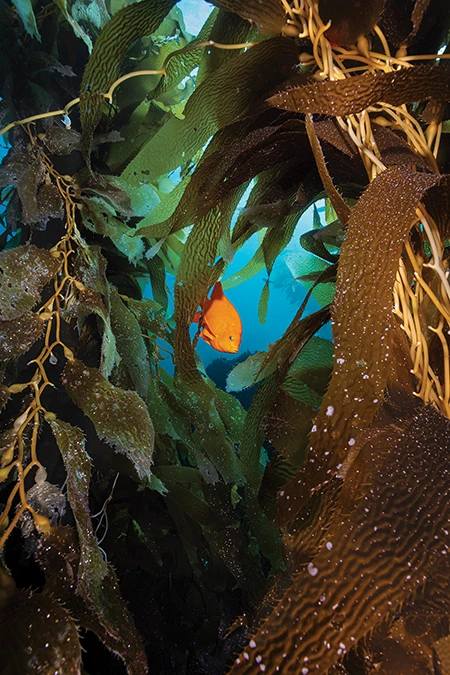
The Channel Islands host submerged giant kelp forests. At 100 feet (30.5 meters) or more in height, the kelp creates a dense, sunlight-filtered canopy. The first time I dropped into this subaquatic world I thought of the children’s fairy tale, Jack and the Beanstalk. Divers descend into a forest of towering underwater trees seemingly from another realm. Just as the beanstalk grew overnight, giant kelp is one of Earth’s fastest-growing organisms, with the potential to grow up to 2 feet (0.6 m) in a single day.
To further investigate the Channel Islands’ biodiversity within their vulnerable, unique environment and to advocate for ocean protections, Oceana and Blancpain came together to conduct three ambitious scientific research expeditions between April 2024 and November 2025.
As one of the world’s most influential ocean advocacy organizations, Oceana has a mission to protect and restore our global oceans. It has had more than 325 victories and protected more than 4 million miles (6.4 million kilometers) of coastline since its 2001 founding. The organization is committed to scientific research for furthering ocean conservation.
Oceana’s goal for this specific expedition states, “Characterizing this biodiversity and identifying important ecological areas will enable us to better protect this special ecosystem and the marine life that makes these ocean waters globally important. These scientific efforts are in support of Oceana’s campaign to protect ocean animals and ecosystems in Southern California.”
The prestigious Swiss watchmaker Blancpain also helped drive these expeditions through its financial support and continued commitment to ocean exploration. Creators of the first true diver’s watch in 1953, the Fifty Fathoms, Blancpain is well-known for high-quality watches. But some people may not know that Blancpain is also a world leader for ocean conservation, supporting numerous international science and photography projects, such as Laurent Ballesta’s Gombessa expeditions throughout French Polynesia and the Mediterranean.
For the third Oceana–Blancpain Channel Islands expedition, my role was to share my unique photographic perspective of Santa Catalina’s underwater environment and its inhabitants. I was eager to meet the international team, with members from the U.S., Mexico, and the Philippines, and excited to hear about what they had seen.
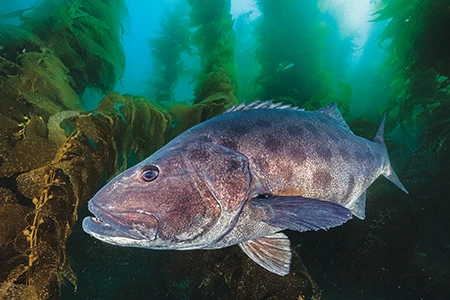
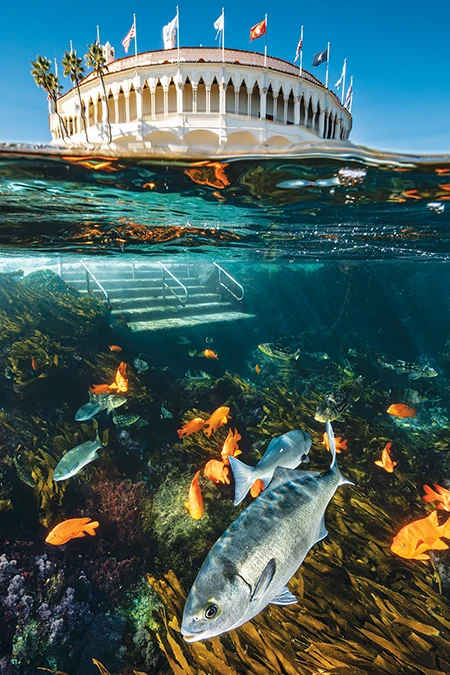
It seemed fitting that for group introductions we each named the animal we most hoped to see that day. I wasn’t surprised to hear that almost everyone said a giant black sea bass, which is one of my favorite local inhabitants. Although critically endangered, these 100-pound (45-kilogram) fish congregate among the rocky kelp beds at Casino Point to mate and spawn.
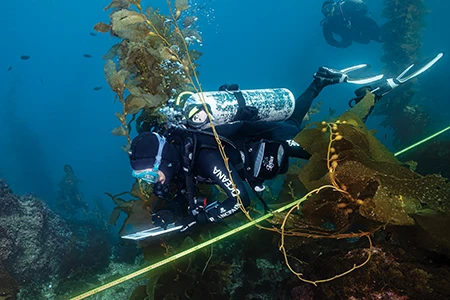
While diving at Casino Point with the Oceana–Blancpain teams, I observed scientific divers performing swimming transects with clipboards and waterproof pencils in hand. They weaved between the kelp stalks with a long tape measure, carefully gliding just above the ocean bottom as they recorded the various species and habitat features. I was impressed by the ease with which they took notes while maintaining perfect buoyancy and taking care not to disturb the environment.
To further investigate local biodiversity, another scientific team collected environmental DNA (eDNA), which is the genetic material shed by organisms in the water column. By collecting samples of mucus, feces, or tissue particles, scientists can process eDNA to identify species and measure biodiversity in an area, thus making new discoveries about marine life. It would be useful to know if an invasive species is present, for example, or the prevalence of an endangered species, such as the giant black sea bass.
Even though I taught advanced placement biology for 19 years, I had never witnessed eDNA sampling, so I was fascinated to see the process in action underwater. It was intriguing to watch the divers doing figure eights, swinging and rotating sealable bags to collect seawater containing fragments of eDNA from an unknown number of species. They filtered the water through a submicron filter on the boat, trapping DNA-rich organic matter, and analyzed it to determine the species present in water samples collected at different depths from the various islands.
From my involvement in this small part of the overall expedition, it was clear how hard the entire team worked and how enthusiastic and committed they were to making new discoveries while promoting ocean conservation. Despite having limited space on the boat and doing multiple dives per day, followed by data analysis and gear organization, everyone was eager to get into the cold water and make meaningful contributions.
The team came together to work at Santa Catalina and the lesser-visited Channel Islands. Each of the three expeditions between 2024 and 2025 lasted five days. By collecting numerous data samples across the three expeditions, the team will provide vital new information about biodiversity and the need for additional conservation measures.
We did not see a giant black sea bass that day. We don’t know if it was because we were outside the main mating season or because their numbers are dwindling, but perhaps the expedition’s scientific conclusions will provide answers.
The giant black sea bass are critically endangered due to historic overfishing, but they have been showing signs of a slow recovery in Southern California. They are a protected species, so direct or commercial fishing is prohibited, but they are still subject to accidental bycatch in gillnets, which makes Oceana’s objective to reduce entanglement in set gillnet fishing gear off the Southern California coast even more noteworthy.
Researchers will provide the results from this three-part expedition when they release the final report, which is planned for later this year. It was an honor to be part of this exciting and inspirational effort, and I hope we can all become better stewards of our planet by taking part in important conservation practices, such as those led by Oceana and Blancpain.
Explore More
See more in this video.
© Alert Diver – Q2 2026