The Legendary Ama of Ise-Shima
The sea is warmer than I expect. I duck beneath the surface of Ago Bay, Japan, and immediately lose sight of the small boat. There is only green light, rock, and a flash of white moving below me — an ama diver finning across the seabed, unhurried and at ease.
I kick after her.
It’s the fulfillment of a years-long dream: diving alongside Japan’s ama, the legendary sea women who have been freediving the Kii Peninsula for nearly 2,000 years. For centuries they supplied abalone to the Imperial Court and to Ise Grand Shrine. They helped build Japan’s pearl industry. And they’ve done it all on a single breath.
Now you can join them. Between April and November, visitors aged 13 and above can book a 45-minute dive with active ama off the Kii Peninsula. Small groups — typically two or three guests per diver — head out by boat, learn breath-hold techniques, and enter the water together.
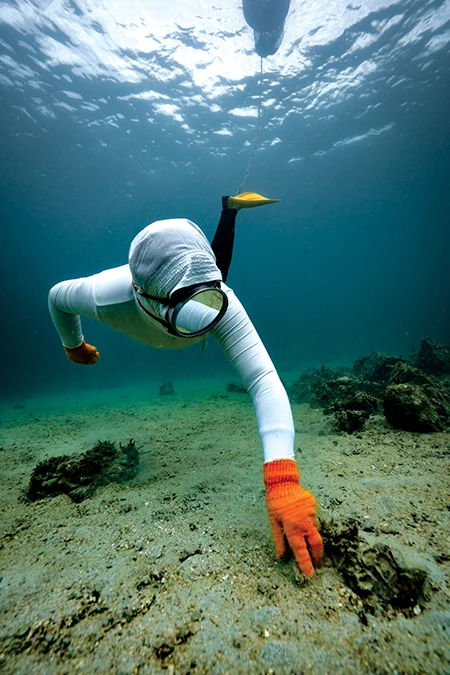
On my third descent, I spot a turban shell half-buried in the sand and scoop it up triumphantly. It’s a small victory.
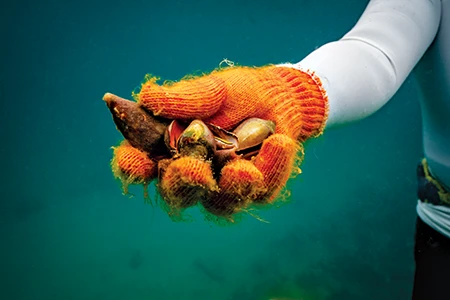
A few descents later, I’m wrestling a spiny sea urchin with my bare hands. It refuses to budge. Ama carry a short metal bar to pop urchins and abalone from the rocks. I have nothing but misplaced confidence. My lungs begin to burn, so I abandon the fight and kick for the surface, gasping for air as I break through.
With 16 years as an ama diver, 63-year-old Hitomi Okumura smiles beside me. “You have young breath,” she said.
We met that morning at Kashikojima Port in Ise-Shima, Mie Prefecture, home to roughly half of Japan’s remaining ama. While there were between 6,000 and 10,000 divers nationwide in the mid-20th century, today the total is closer to 2,000. The average age hovers around 70 years old. Young divers are rare. Here the youngest is nearly 50.
Historically, girls began training as early as 12 or 13, learning from mothers and grandmothers. Women were believed to withstand cold water better because of their higher body fat composition; in fishing villages where men went offshore for extended periods, women harvested closer to shore. Over time, ama diving became one of the world’s rare female-dominated maritime professions.
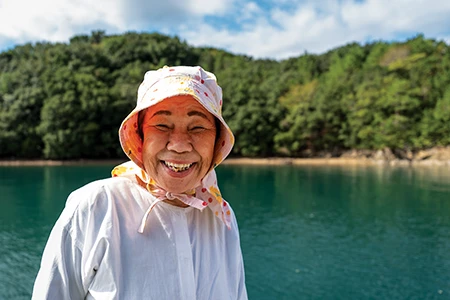
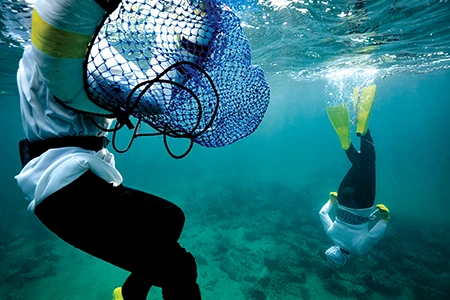
For generations divers wore little more than a loincloth and a headscarf. In the early 20th century, as Japan’s cultured pearl industry expanded under Kokichi Mikimoto, the now-iconic white diving uniform — symbolizing purity and, according to folklore, warding off sharks — became standard for ama. Today many divers use modern wetsuits for warmth, though white hoods and traditional garments remain part of the identity.
Ama divers never use tanks, and that hasn’t changed in 2,000 years. Instead, they take a deep inhale, fold at the waist, and drop in for a clean descent.
Kimiyou Hayashi, 71, moves through the water with a grace honed over 56 years. Her mother and grandmother were ama. As a child, she learned to swim in the sea. At 15, she traveled to San Diego, California, to perform in an ama dive show at SeaWorld’s Japanese Village before returning home. She officially earned her ama title at 29 and has been diving ever since.
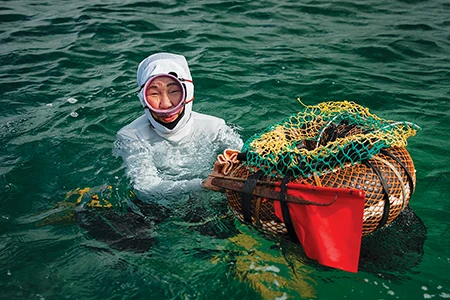
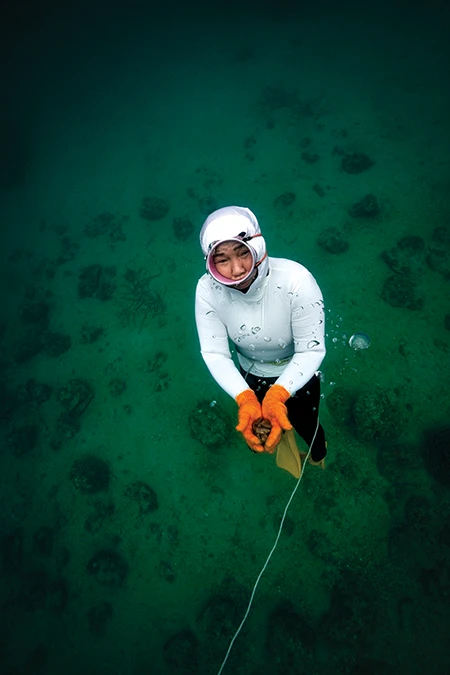
In her youth, she descended to about 50 feet (15 meters) — a depth that requires calm lungs and exceptional control. She still dives several times a week as weather allows, typically in short morning sessions of one to two hours, in accordance with cooperative regulations designed to prevent overharvesting.
Between dives, Hayashi and Okumura rest on floating wooden tubs or buoys, dropping their catch inside before descending again. Nets dangle from the interior of their life preservers, filling with our catch. Each resurfacing ends with a sharp, controlled whistling breath, the isobue. The once common sound is increasingly rare along these shores.
“Right now, the sea has totally disappeared,” Hayashi said, referring not to water, but to the region’s dwindling seaweed forests.
Rising ocean temperatures around Japan — increasing at roughly twice the global average — have contributed to isoyake, or “barren sea” conditions, in which seaweed and kelp forests collapse and ecosystems lose biodiversity. The main catches for ama, such as turpin shells or the valuable abalone, depend on those seaweed beds for food and shelter. Say sayonara to the seaweed, and everything else follows.
Climate degradation is a forceful reason that ama numbers are dwindling. Many people want to become ama, Hayashi said, but the catch is too small to support somebody these days: “If they cannot catch, they cannot live.”
The tourism initiatives that the ama developed roughly eight years ago has become a crucial alternative. Many long-standing ama have exited the profession to work in one of the area’s many hotels or restaurants. Hayashi diversified out of traditional ama harvesting to leading tours and serving meals at our next stop, Ama Hut Satoumian.
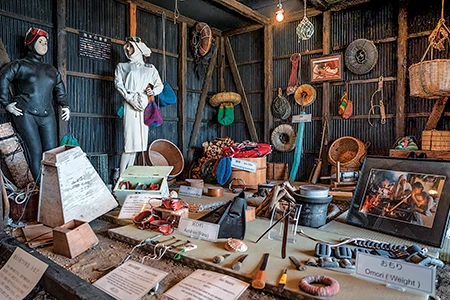
A line of small huts sits outside a central building at the restaurant. Pry bars, glass-and-net buoys, masks, nets, and other dive paraphernalia are spread out on the ground when we enter the main structure. This earthen display gives diners a full exhibition of what it historically took to get seafood to shore here.
Iso nomi, I learn, is the name of the chisel used to pry sea urchins from rocks. I wish I had that this morning.
This restaurant, and others like it, are inspired by traditional amagoya, seaside huts where divers gather before and after dives to pray and warm themselves around a hearth. The firepits were also used to cook a communal lunch from the morning catch.
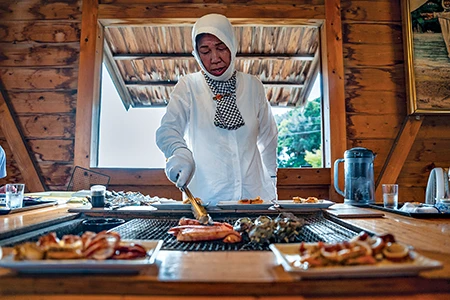
Inside, smoke curls upward from a charcoal grill. Bowls of miso soup with aosa seaweed and seasoned hijiki rice appear while Hayashi stands at the fire in her white hood. As rain starts to fall, she cooks a veritable feast of whole abalone, fresh scallops, a turban shell, squid, and dried fish. While none of the food comes from our catch-and-release harvest, it offers a direct view into the daily lives these women shared for centuries.
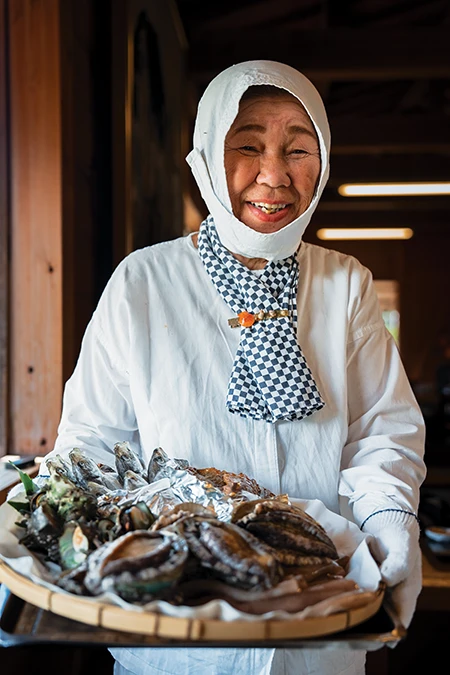
After lunch, Hayashi leads me to her personal hut. It sits close to the shore, simple and weathered. The sea is steps away. Hooks line the wall where wetsuits once hung shoulder to shoulder.
The hearth is built for a circle of women. She once shared this space with 10 other divers, having lunches that were likely as boisterous as the one we just shared. But now she uses it alone. All her colleagues have died.
Hayashi tells me she would love to have a mentee, but no apprentice is waiting in the wings. Each visitor who slips beneath the surface beside her briefly becomes that conduit: not a successor — the amatradition cannot be inherited in an afternoon — but a witness.
We carry the rhythm of her breath back to the surface with us. We tell the story. We remember the whistle. And in that remembering, what she knows travels farther than Ago Bay. Before the breath runs out, it moves through ours.
Explore More
See more with these videos.
© Alert Diver – Q2 2026