Kalaallit Nunaat
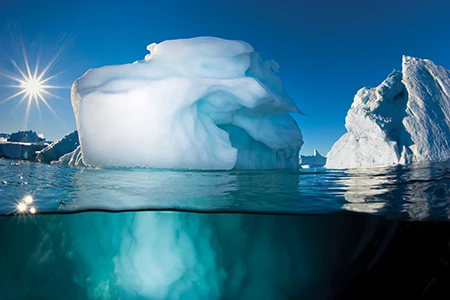
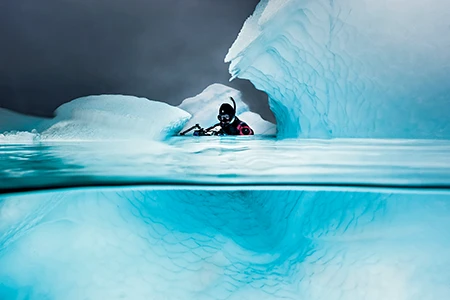
We swam into a gallery of grounded icebergs towering toward a cloudless blue sky and descended into the depths to better understand these secretive giants. They growled like distant thunder as they shifted on the bottom far below until the torque and tension released with an unsettling, gunshot-like crack. The textured ice captured sunlight penetrating the sea and reflected it back as a shimmering green aura.
We swam into a gallery of grounded icebergstowering toward a cloudless blue sky and descended into the depths to better understand these secretive giants. They growled like distant thunder as they shifted on the bottom far below until the torque and tension released with an unsettling, gunshot-like crack. The textured ice captured sunlight penetrating the sea and reflected it back as a shimmering green aura.
We rose slowly until we reached the surface and trained the camera lens to see above and below the water, and it was there that we learned something. An iceberg is the perfect metaphor for the sea. A very small percentage is visible to our human eye, and the rest remains hidden from our view.
This visit provided us with a glimpse of Greenland, the largest producer of glacially calved icebergs in the Northern Hemisphere.
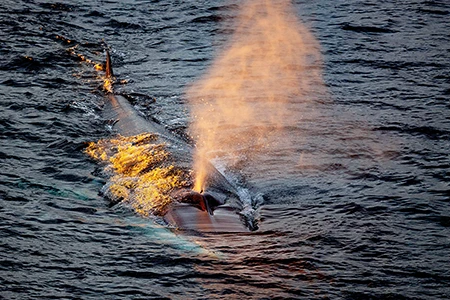
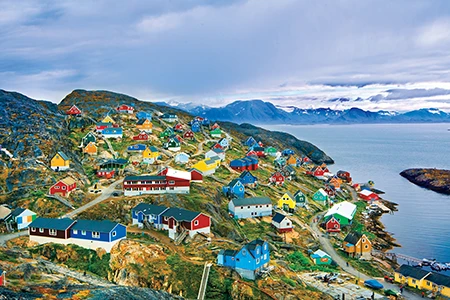
A curious minke whale slowly followed our Zodiac’s wake as we made our way into a channel leading to the coastal community of Kangaamiut. We were tying up when we saw townspeople leaving their homes and shops, rushing past us, and jumping into several smaller outboard motorboats.
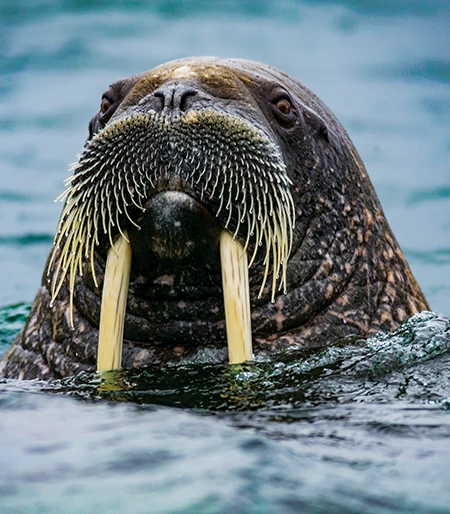
We watched as the boats followed the minke through the short channel into the open sea and formed a circle around the cetacean. Within minutes it was over. The whale would become valuable protein for the people in this isolated settlement.
This is Greenland: unapologetically raw, remote, and wild. Hunting and fishing have shaped the culture here for 4,000 years.
Kittat Economusée is a renowned workshop in old Nuuk that creates traditional Greenlandic costumes. I was invited to observe two Inuit women prepare seal pelts for avittat, a form of sealskin embroidery that adorns the Greenlandic national costume. I thanked them for sharing how Arctic seals are deeply embedded in their culture, and then I walked from the colonial harbor to the Nuuk Center Mall to browse high-tech electronics, expensive Danish home goods, and the newest items from Patagonia, North Face, Fjällräven, and Scandinavian designers that I could not begin to afford.
This is also Greenland: the fast-growing capital city of Nuuk, nearly as trendy as Copenhagen but with only three traffic lights, one tunnel, and a whopping network of 75 miles (121 kilometers) of road for about 20,000 residents, mostly of Inuit and Danish descent.
Located north of north, Greenland is like no other place on the planet. You get a sense of where you are when you see a town dispatch a whale in 20 minutes or watch a 20-foot (6-meter) boat struggling to dock under the weight of hunters and a field-dressed musk ox.
You might then forget where you are when you order and pay for your latte, Italian gelato, or musk ox burger on a sleek digital platform without a human in sight. There are no roads, railways, or inland waterways connecting coastal settlements. There are about 240 miles (386 km) of road in the entire country, which is three times the size of Texas.
Greenland is towering iceberg galleries, glaciers, ice sheets, fjords, hunters, fishers, boats, dogsleds, sled dogs, Thule mummies, Danish influence, soft-spoken people, art, and rare earth elements. And yes, it is diving and snorkeling.
Greenland is also quite complicated. It is not an independent nation but an autonomous territory of the Kingdom of Denmark. As Danish citizens, the people are also citizens of the European Union (EU), but Greenland does not belong to the EU.
Greenlanders call their homeland Kalaallit Nunaat, meaning “Land of the People.” After joining many Inuit family dinner tables, I have learned that they take this meaning very seriously. Life in Greenland is not like life in wild Wyoming with convenient access to Walmart. The Inuit rely on the land and sea for survival.
Diving in Greenland
If you like frontier coldwater diving, this is it. The waters are unexplored but surrounded by growing infrastructure. Diving here is about the ice, some wrecks, and kelp. If you are very lucky, you may experience an occasional encounter with larger Arctic wildlife that work hard to keep a good distance from all humans, especially during hunting seasons that fill freezers for the long winter ahead.
The best diving is from June through September, but it’s not completely limited to those months. Many fjords remain accessible in winter. For the intrepid among you, however, remember that daylight is short in the south and shorter as you go north. The temperatures are subzero, the visibility is usually very clear, and the diving is as challenging as you would expect.
Divers can find land-based and liveaboard operations in larger settlements such as Sisimiut and Ilulissat in West Greenland and Tasiilaq in East Greenland. Large and small chartered expeditions offer extensive exploratory dive platforms in extremely remote areas with the benefit of expert naturalists and guides.
If you are not a seasoned coldwater diver, Greenland is not the place to start. Growing infrastructure roughly translates to a lack of established emergency services. There are no civilian-accessible hyperbaric chambers for treating dive emergencies there. Divers in Greenland, particularly in remote areas, are hours or days away from help; the nearest recompression capabilities are in Iceland, a two-hour flight after fetching you out of a fjord, if you are even fetchable.
It is highly recommended — more like essential — for divers and snorkelers exploring Greenland to have dive accident insurance, such as DAN’s, that covers medical evacuation. It’s useful not only for the expense involved but also for the expertise in dealing with emergencies in remote locations.
Wildlife
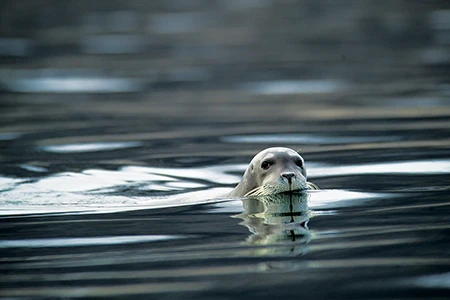
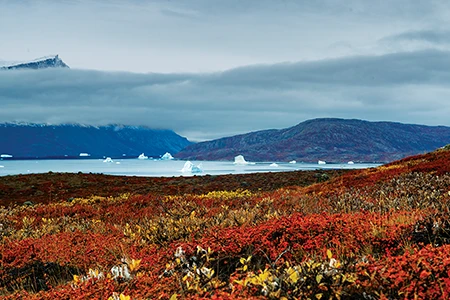
Unlike in Antarctica, Arctic wildlife is hunted; if they could, the animals would likely choose to be completely invisible. Polar bears and walruses are elusive and do not crowd every coastline. Sighting them at the end of a long lens is rewarding. Specialized bear experiences are available through licensed operators with strict rules. Greenland does not allow nonresident polar bear trophy hunting.
The Melville Bay Nature Preserve in Northwest Greenland, north of the Upernavik Archipelago, is a protected marine area with large icebergs and extensive glaciers. The preserve is a prized summer habitat for narwhals, belugas, seals, and polar bears. Narwhals and belugas feed along the glacier fronts.
Near-constant ice calving makes diving or snorkeling near a glacier a suicide mission. If you submerge away from the high activity, however, you can listen to narwhal and beluga conversations while you photograph the more stable ice around you.
Narwhals are as prized for Inuit hunters as they are for tourists and divers. Hunters seek narwhals for their meat and highly coveted long, spiraled canine teeth. Harvested cetaceans and seals are butchered in hunting camps away from settlements.
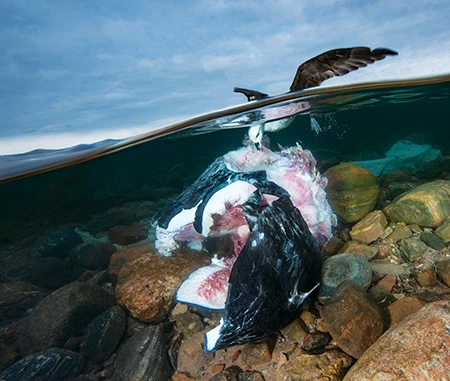
Snorkeling the shallows off these areas lets you see the history of the hunted. The Marine Mammal Protection Act makes it illegal to import marine mammal products into the U.S. without specific, limited permits. Leave the baleen, whalebone, seal skin, and walrus ivory in Greenland.
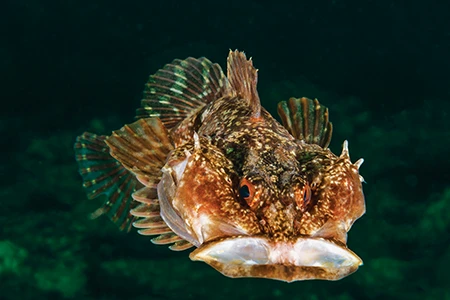
if it fits in your pocket.
The Ice
Scoresby Sund, East Greenland, is the largest and deepest fjord system in the world. It is a reservoir for enormous icebergs from the Greenland ice sheet. These islands of ice can tower nearly 300 feet (91 m) above the surface and scour the bottom 1,640 feet (500 m) below.
Red Island is a garden of grounded icebergs. It is a living gallery where the artist is a combination of wind, weather, and currents that continuously sculpt the ice until the center of gravity shifts and the iceberg rolls, starting the repeating process again. Diving and snorkeling here is breathtaking as you fin among towers and fingers of ice, but it comes with some risk: The bergs do roll and shatter, filling the sea with needle-sized shards of ice. The arches may topple, or grounded bottom ice may break and shoot upward like a surfacing submarine.
Ilulissat, a coastal town in West Greenland, lies at the edge of the Ilulissat Icefjord, a UNESCO World Heritage Site and a great place for glacier nerds to observe the Sermeq Kujalleq glacier, one of the world’s most active glaciers and likely the one that produced the infamous iceberg that sank the Titanic. A modest boardwalk hike leads you to the glacier and incredible opportunities to see, hear, and feel its power as it grinds past on its way to the sea a short distance below.
The Sermeq Kujalleq glacier produces more than 10% of Greenland’s calving ice, filling the bay with brash ice and colossal icebergs. There are long waiting lists for the tour boats that weave their way through the ice. There is fabulous snorkeling with opportunities for above and below images, and if you are lucky you may hear or see humpbacks navigating the labyrinth of newly calved ice.
Climate Change
Arctic temperatures are rising at twice the global rate. In August 2025, we left Nuuk, Greenland, by making our way through the Northwest Passage to Nome, Alaska, in 23 days. Roald Amundsen needed more than three years to complete the same transit in 1903 due to the ice.
Greenland’s melting ice sheet is the largest source of global sea level rise. Some models predict that if the Greenland ice cap melts, we will see a 24-foot (7.3-m) rise in sea level. No models predicted the permafrost collapse in 2017 that triggered a 200-foot (61-m) tsunami that roared over the town of Uummannaq, causing widespread destruction of homes and the death of people and sled dogs. Greenland is the world’s vast vault of ice and a global climate barometer.
Greenland Now
I have journeyed to remote Greenland by expedition ship many times since 2012, but I had not managed to reach Nuuk, Greenland’s only city, until February 2026. My visit provided insight into Greenland in the winter and let me explore Nuuk Fjord and take Greenland’s emotional temperature in light of the controversial suggestion that it should become a part of the U.S.
There were as many journalists in town as residents, all having conversations with locals about politics. I was there for nature, but politics always found a way into the conversation. I was invited to dinner tables, where I listened to children and parents express disbelief, confusion, and fear.
Greenlanders are a soft-spoken people who often communicate more with their eyes. Nature is their compass, and they are typically gentle. They welcome visitors to Kalaallit Nunaat and hope they leave with an understanding of why Greenlanders call their beloved country Land of the People.
How To Dive It
Getting there: Year-round flights depart from Copenhagen, Denmark, and Keflavik, Iceland, and seasonal flights depart from Newark, New Jersey, and remote Iqaluit, Canada. The stopovers are a benefit for travelers, who can spend time enjoying these gateways. If you appreciate Greenland, you are likely interested in Iceland as well, and this is an easy way to visit both.
If you are like my partner, David Doubilet, you have Iceland’s tectonic plate dive at the Silfra fissure on your bucket list. Clear glacial water, with visibility sometimes exceeding 330 feet (101 m), is the incentive to dive in near-freezing water there.
Three civilian airports in Greenland can land midsize jets: Nuuk, Kangerlussuaq, and Narsarsuaq. Nuuk’s airport was expanded in 2025 to accommodate larger aircraft and boost tourism, and it now has a baggage carousel and a duty-free shop. Kangerlussuaq is a regular charter flight hub for cruise ships, while visitors who use Narsarsuaq most likely have relatives there.
Flights within Greenland are easy to book with Air Greenland, but they are weather-dependent, and you might get stuck somewhere for a few days. Regular flights are available from Nuuk to Ilulissat, Kangerlussuaq, Sisimiut, Maniitsoq, and Aasiaat on the more populated western coast, and Kulusuk is the gateway to Southeast Greenland.
Sea expeditions and sailing tours, especially aboard small ships, are the best way to explore Greenland’s remote coastal waters, fjords, glaciers, and galaxies of icebergs in summer and into fall. The distances are vast, but the reward is the journey.
Explore More
See more of the Greenland in a bonus Facebook Reel and YouTube videos linked below.
https://www.facebook.com/reel/896018906503733
© Alert Diver – Q2 2026