MEMBER PROFILE
Hometown: Pompano Beach, Florida
Age: 66
Years Diving: 53
Why I’m A DAN Member: I’ve encountered dive emergencies from every vantage point: on the phone, in the chamber, and at the bedside. I understand that DAN is not simply an insurance provider; it is a coordinated medical system that brings order and expertise to critical moments. When seconds count, structure, preparation, and coordination change outcomes.
Like many divers of a certain age, Marc Kaiser grew up watching early underwater-based, black-and-white television shows. His family’s first color TV arrived in 1968, just in time for The Undersea World of Jacques Cousteau, but his fascination with diving began earlier.
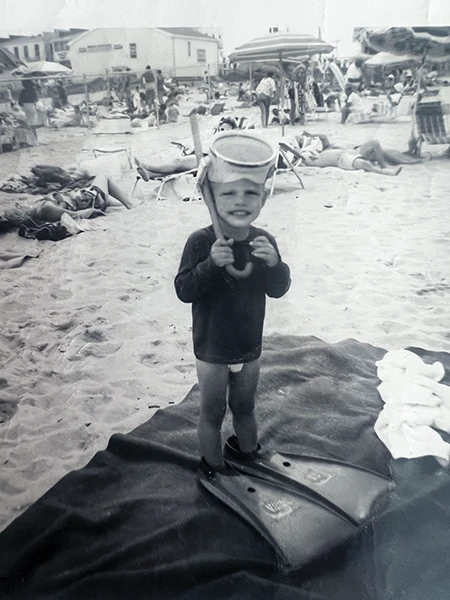
In the mid-1950s his father was stationed with the U.S. Navy in Guam and learned to scuba dive there. As a child, Kaiser listened intently to his father’s stories and studied his shell collection, imagining himself underwater one day. By the time he was able, he was snorkeling in the shallows, collecting shells, and watching fish.
At age 13 he enrolled in his first dive class in Norfolk, Virginia, at a shop that trained military personnel and employed several Navy master divers. He received his certification the week of his 14th birthday. By 15 he was a certified Scubapro repair specialist, and by 16 he was a provisional National Association of Scuba Diving Schools (NASDS) instructor. Even then his plan was to be self-employed, working in or under the water.
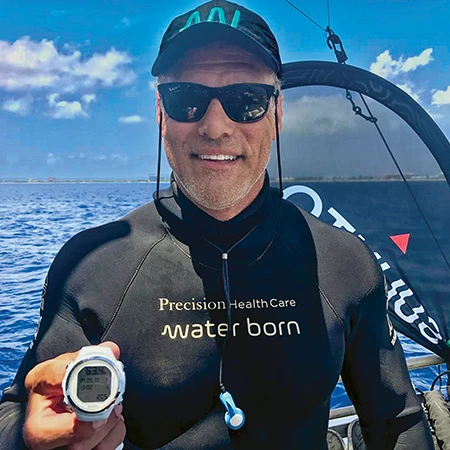
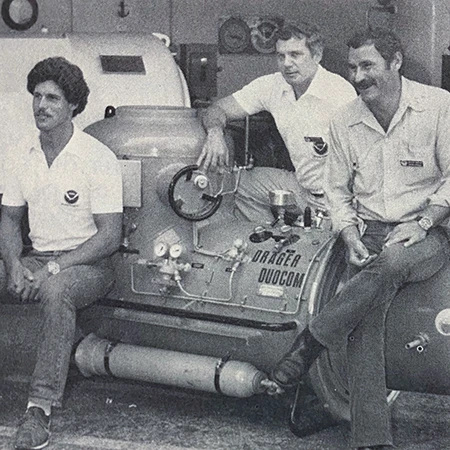
Kaiser worked as a shipyard diver in Norfolk during the summer after his freshman year of college before relocating to Miami, Florida, to continue his marine science and engineering studies. There he met Rick Frehsee, a part-time professor and emerging figure in dive photojournalism as a freelance underwater photographer for National Geographic, Skin Diver, and other publications. The two later collaborated on the 1980 U.S. Divers catalog in St. Croix.
During a class tour of the National Oceanic and Atmospheric Administration (NOAA) hyperbaric facility at Virginia Key, Kaiser met Frehsee’s friend, Dick Rutkowski, who would later become his mentor. With strong endorsements from Frehsee and the college dean, Rutkowski invited Kaiser to work and participate in an upcoming hyperbaric training program held by NOAA and the Undersea and the Hyperbaric Medical Society (UHMS).
The program lasted three weeks, six days a week, with days often stretching to 14 hours. Sundays were spent diving in Key Largo. Kaiser went on to become one of the program’s principal instructors, serving alongside Rutkowski and Morgan Wells for the next decade. During those years he forged relationships with many of hyperbaric medicine’s early pioneers, including Peter Bennett, who founded DAN in 1980 at Duke University Medical Center. This group helped define and expand the science of hyperbaric medicine, refining treatment for decompression illness and broadening its application into wound care and other medical disciplines.
After his internship, Kaiser worked part-time at NOAA Diving as a student and then was hired as NOAA’s first instructor of diving and hyperbaric medicine. At 21, he was the youngest NOAA unlimited certified diver, a certified dive medical technician, and an instructor with the National Association of Underwater Instructors (NAUI). He also served on the NOAA Diving Control and Safety Board and as a line diving officer for approximately 360 of NOAA’s scientific divers.
From 1985 through 1988, following Rutkowski’s retirement, Kaiser served as acting director of the NOAA Diver Hyperbaric Training Center. During this period he also operated a consulting company that assisted with hyperbaric chamber installations overseas.
Kaiser’s work with NOAA led to missions to Hydrolab, an underwater saturation habitat deployed off St. Croix. Serving on a two-person dive team, he provided 24/7 safety support for aquanauts living and working at depths of up to 150 feet (46 meters), gaining a rare inside view of saturation research and life on the seafloor.
Kaiser also participated in the NOAA and Oceaneering saturation experiment at Duke University, evaluating nitrogen tolerance as a potential alternative to helium. He was one of 10 NOAA and Navy divers who were saturated for nine days at 165 feet (50 m), breathing a 95% nitrogen and 5% oxygen mix, with daily air excursions to 200 feet (61 m). While the experiment yielded valuable data, nearly all participants developed decompression sickness and required treatment — a powerful reminder of diving’s inherent risks.
In January 1989 Kaiser and three physicians established the Hyperbaric and Problem Wound Center at Miami’s Mercy Hospital, also known as the Diving Medical Center. Kaiser bought out his partners two years later and continued operating the center until October 2011. The program ranked among the busiest hyperbaric treatment centers for sport divers in the U.S. and was one of the few hospital-based programs in the country equipped to provide around-the-clock, critical-care hyperbaric services 365 days a year.
Kaiser also volunteered with DAN as a chamber program evaluator for Caribbean facilities and served as regional coordinator for Florida and the Caribbean. Additionally, he served on the UHMS Safety Committee for many years. He founded Precision Health Care Inc. in 1998 to provide turnkey wound care and hyperbaric programs for hospitals and governments — work that remains his primary professional focus.
For a man whose entire career involved compressed gases, physics, and physiology related to diving and chamber applications, freediving is one of his great passions. He spent a great deal of time traveling from his home in South Florida to snorkel in the Bahamas with his two daughters. Because they were too young to become certified scuba divers, Kaiser pursued formal freediving training, initially for himself and to ensure he and his daughters remained safe.
His friends recommended Performance Freediving, run by Kirk Krack, Mandy-Rae Cruickshank, and Martin Štěpánek. After speaking with them, he enrolled in their local Intermediate Freediver course, during which he discovered things about himself and human physiology that he had not known, despite his professional background.
The experience culminated in a static breath hold of 5 minutes and 17 seconds on his first attempt. He arranged a meeting with Krack, and as his skills improved, his world expanded. They remain good friends and collaborated with Goh Iromoto to create Water Born and Water Born TV, producing a series of YouTube and Facebook videos on freediving.
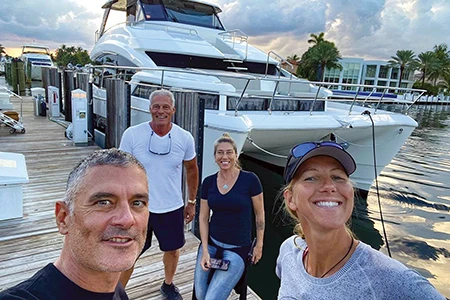
Among Kaiser’s many achievements, he was honored as the DAN/Rolex Diver of the Year in 2002, and he set the U.S. Freediving Masters Division record in Men’s Variable Weight at 208 feet (63.4 m) on May 21, 2017.
Now 66 years old, with a wife and two grown daughters, some of his most aggressive exploits are behind him. He continues to spend time in and under the water, guided by the same curiosity that began with a shell collection and a black-and-white television and supported by the safety network he trusts when it matters most.
Explore More
See more in this video, “Marc Kaiser Record Dive.”
© Alert Diver – Q2 2026