Jim has been a certified PADI diver for 50 years and is a certified open water instructor and an underwater photographer specializing in shark images. He has logged a few thousand dives, including 15 to 20 shark dives every week. His experience has taken him diving well into the Gulf Stream and drifting with the multiple species of sharks found offshore near Jupiter, Florida. He is a retired fireman who always helps on deck and in the water, keeping a wary eye on other divers, whether local or tourists.
Shark tourism has become increasingly popular. During predive briefings, operators educate the divers about local shark behavior and appropriate diver conduct while diving with sharks as well as shark conservation and protection.
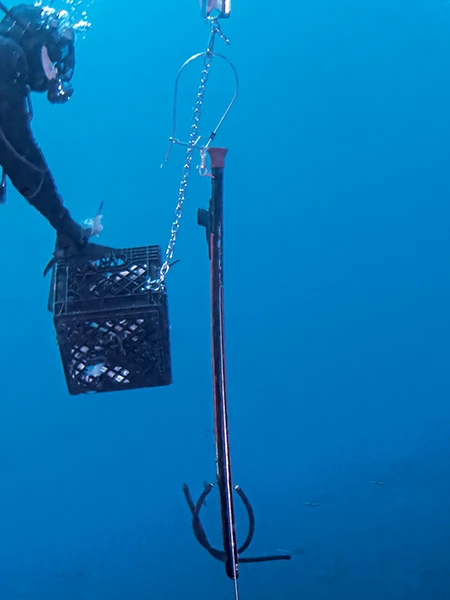
Jim was having a great time on a dive with lemon sharks, and all the other divers seemed relaxed. The shark feeder was tending to a crate of fish chum that was dangling from a line to the surface dive flag. A speargun and a latched metal hoop fish stringer were on the line just above the crate in case the feeder needed more fresh fish.
Lemon sharks were swirling around the crate and the divers. As the dive ended and the group ascended to 15 feet (4.6 meters) for their safety stop, Jim began his routine of turning off his camera and strobes and folding the strobe extension arms in preparation to surface. It was then that he noticed that the shark feeder was not tending to the chum crate.
One shark suddenly swam into the metal stringer. Its strong forward thrust caused the shark to get trapped by the fish stringer, which wedged around its gills and snout. The other sharks were still churning around the divers. The trapped shark thrashed in a frenzy, trying to free itself, but the stringer was held fast within its gills. Finally, the shark went limp with fatigue.
Jim handed his camera gear to his dive buddy and slowly approached the limp shark. He was going to try to release the latch and free the shark from the entrapping stringer. As he was reaching toward the latch with his arm fully extended, the shark feeder, hoping to help, grabbed and pulled the shark’s tail at the same moment.
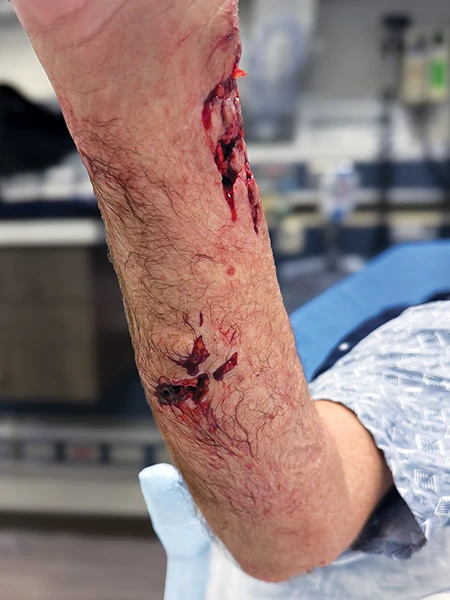
The shark panicked, pulled free of the stringer, flipped over, and snapped at Jim’s extended arm. Jim felt the needlelike teeth penetrate his 5 mm wetsuit, sinking into his forearm. The shark held on while thrashing and then released and swam away. A cloud of blood issued from the puncture wounds.
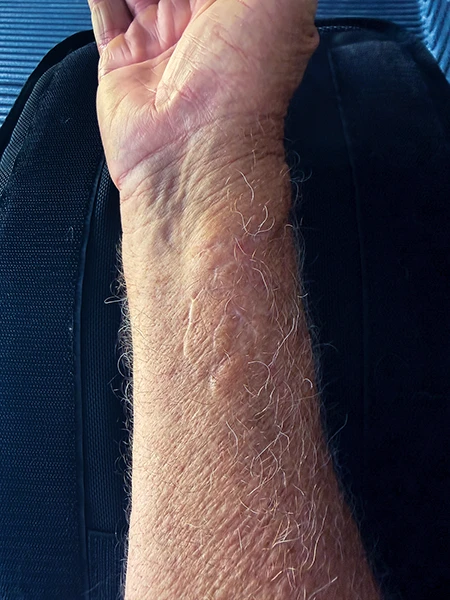
Other divers assisted Jim back onto the boat. The deckhand appropriately applied a tourniquet just above the most proximal injured area of Jim’s forearm, elevated the arm, and then cleaned and dressed the wounds. Fire rescue met the boat at the dock and took Jim to the hospital, where he had surgery to repair two torn tendons and his lacerated skin. After the surgery, he had a course of multiple broad-spectrum antibiotics. Eight months after the incident he had regained full function of his arm, and his wounds had healed well.
As DAN has previously published in several Alert Diver articles,there is usually a cascade of events that lead to an adverse event. Root cause analysis frames adverse events as having four phases that can result in a serious outcome or death: the trigger, the disabling agent, the second disabling agent, and the cause of the serious outcome or death. Each phase is avoidable; if you can recognize them when they occur, you can react and lessen or eliminate the problem.
Unfortunately, the serious injury or outcome is not always due only to the diver who initiated the events, as in Jim’s case. The Phase 1 trigger was the shark feeder leaving the chum crate unattended. The first disabling agent, Phase 2, was the lemon shark swimming into and becoming wedged in the stringer. Phase 3, the second disabling event, was the shark feeder pulling the shark’s tail. Phase 4, the serious outcome, was the shark bite. If the shark feeder had not abandoned the chum crate, all these phases could have been avoided.
With more awareness of the situation, the feeder could have also stopped the second disabling event, and more communication about handling the situation may have prevented the eventual bite. The loss of focus by the shark feeder at critical moments and the lack of communication during a frantic, stressful situation ultimately resulted in the serious outcome of Jim’s shark bite injury.
© Alert Diver – Q4 2026