I took a large group of divers to Fiji. We divided into four groups for diving, each with our own divemaster. Toward the end of the week, everyone was doing fine, including the newer divers. Everyone was comfortable, relaxed, and having fun between dives.
For the second dive of a two-tank boat trip, the divemasters had changed all our cylinders for us. As it sometimes happens, my dive buddy and I had become less strict about doing a buddy check, choosing instead to be social and share dive stories as we geared up. We glanced over our own setup but didn’t check each other.
Our group did a giant stride into a beautiful 70-foot (20-meter) wall dive with almost no current. After dropping to near the bottom of the wall, we checked with everyone and headed off. Our small group was fairly independent, and the divemaster let us take the lead as he followed behind.
I have a habit of regularly counting divers. About 20 minutes into the dive, I looked back to the divemaster, who was about 20 feet (6 m) away. His body language seemed tense, so I turned and headed his way, giving the OK sign to check in with him. He signaled that he was out of air, which surprised me because he is an experienced diver. I signaled to him again to be sure I understood, and again he signaled that he was out of air, so I quickly headed toward him.
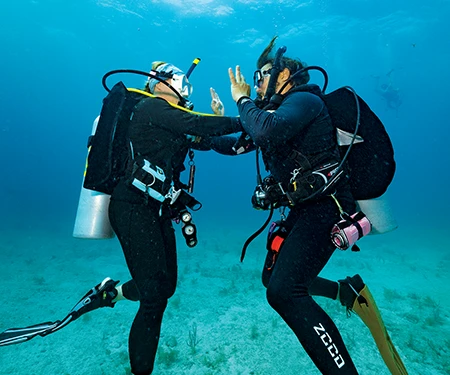
Even though I was the closest person to him, he turned away, looked back, and signaled to a divemaster intern behind us that he was out of air. The intern didn’t seem to understand there was an emergency and slowly headed toward us. Then the divemaster turned toward the surface and started to look up, with his body becoming more tense. I knew he was about to bolt for the surface.
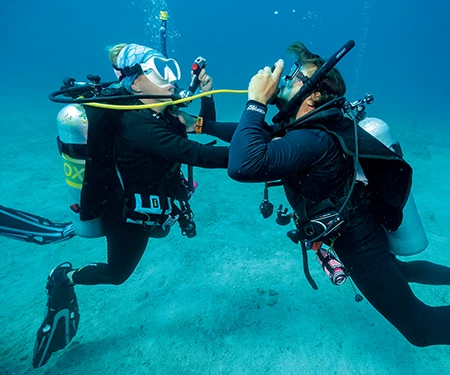
My gear setup requires me to donate my primary regulator in an out-of-air emergency. I had already switched to my secondary regulator and had the hose of my primary in my hand ready to give to the divemaster. In that same moment, I reached his side, grabbed his hand, turned him toward me, and put my regulator in front of his face for him to take, which he did.
We got into the position to share air and then exchanged OKs and signaled to the rest of the group to ascend with us. We slowly ascended to 15 feet (5 m) and completed our safety stop while doing a slow swim so that we surfaced back at the boat. He orally inflated his BCD and was able to safely board the boat.
When debriefing the incident later, we realized he must have switched his cylinder with one that had been used on the previous dive. He had been distracted while helping other divers, and he didn’t check his gauges once, not before or during the dive, until he felt the gas was being limited. He was fully out of air by the time he took my regulator.
“Complacency and distraction are real threats for experienced divers. Over time, we may get used to not checking our own air levels because others call the dive before we need to.”
Even though he is well-trained, in the moment of the incident he didn’t think of sharing air with me, the closest diver. Instead, he was thinking about getting to the surface until I stopped him.
I am an instructor trainer and have practiced sharing air in classes thousands of times, so the skill comes naturally to me now. But I instantly recognized the divemaster’s situation because a similar incident had happened to me.
Before a shore dive in Curaçao many years ago, one of the divers replaced the cap on the cylinder they had just used. Unknowingly, I quickly changed my gear onto that tank so I could help the other divers. The first time I checked my pressure gauge was 10 minutes into the dive, when we had finished our descent to 80 feet (25 m). I had only 700 psi (50 bar) left. I signaled to the other divers that I had to abort my dive and safely ascended with my buddy.
Complacency and distraction are real threats for experienced divers. Over time, we may get used to not checking our own air levels because others call the dive before we need to. During surface intervals, we might be busy helping divers and socializing, so unfortunately we may rush through the critical, lifesaving tasks.
I am an example of how complacency and distraction are real issues, having been both a distracted diver and a rescuer. My buddy and I have recommitted to doing buddy checks on every dive, and you should too.
© Alert Diver – Q4 2026